
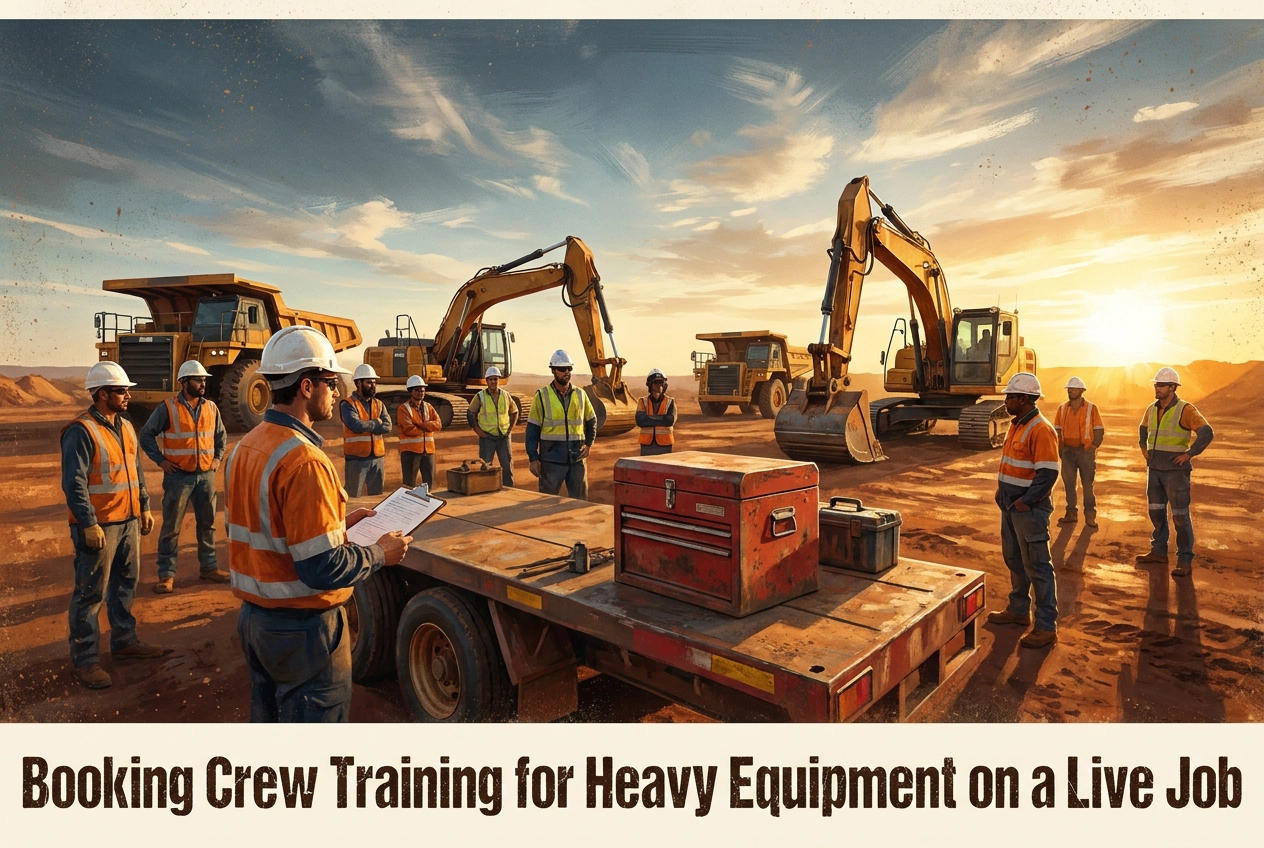
Keeping the crew running while a ticket is expiring is a classic headache for any supervisor. You need the operators trained, but you can’t afford to have half the team off site at the same time. That’s where smart scheduling comes in.
Booking heavy equipment training for a live job is a coverage problem before it’s a training problem. If you don’t plan the sequence, you’ll ground the crew and stall the job. This post walks you through how to do it without the disruption. We’ll cover why it’s a coverage issue first, then go step by step: mapping every machine on site to the ticket it needs, sequencing machines by job need, staggering bookings so no ticket goes uncovered, and clearing licences, USIs and medicals before the booking date. We’ll also look at how six-day availability makes weekend and split-week bookings realistic, run through a worked example with a five-operator crew, and flag common scheduling mistakes that ground a crew.
If you’re in Perth and want a training partner who gets it, A2B Training is an established RTO in Maddington with hands-on practical training, six days a week, combo deals and solid value for money. Let’s get your crew ticketed without the downtime.
Why Booking Crew Training Is a Coverage Problem First
Finding a heavy equipment course is easy. Keeping the job running while your operators are off site is the hard part. Every person you send to training takes a skill set out of the crew for a day or more. Send two holders of the same ticket at once and that machine parks. That is what actually stops work.
One quick term check before we go further. In WA, the regulator uses “licence” for high risk work. “Ticket” is industry shorthand for nationally recognised RII units of competency and VOC outcomes.
So a crew booking is a sequencing exercise. Machines, people and job stages all have to line up before you make the first booking. It helps to think of it like a multi-ticket training plan for a civil construction crew rather than a stack of separate course dates.
This guide covers four things: mapping machines to tickets, sequencing by job need, staggering bookings so coverage holds, and clearing prerequisites before the booking date.
Step 1: Map Every Machine on Site to the Ticket It Needs
Right, let’s get into it. Start by walking the job and listing every machine on the books: excavator, wheel loader, skid steer, roller, telehandler, integrated tool carrier, rigid haul truck, articulated haul truck, watercart. Match each to its unit of competency. If you’re in surface mining, our guide to which RII units apply to surface mining in WA is a handy cross-check for the machine classes.
One thing to get straight early: a ticket qualifies someone for a machine class, not for your site. They’ll still need induction and site-specific verification when they arrive.
Before you quote any code in a booking or position description, verify it against training.gov.au, because codes and machine mappings do change. Then check the WorkSafe WA high risk work licence classes page and the WA.gov.au guide to applying for a new high risk work licence to confirm which classes need a licence on top of a ticket, per the national licensing framework.
Finally, build a simple table: machine, unit code, current holders, who’s next, and how many holders the job needs daily. That’s your gap map. Next, we sequence it by job need.
Step 2: Sequence the Machines by Job Need, Not by Convenience
With your machine-to-ticket table sorted, the next question isn’t who’s free first. It’s what the job needs next.
Rank each ticket by when the machine actually hits the programme. Earthworks and haulage usually come before finishing plant, so book to the programme, not the calendar. That way a freshly ticketed operator returns to a machine that’s about to be used, not one that’s already left site.
Where units allow, pair tickets that share a machine family or site context, so an operator can pick up two related competencies close together. If you’re planning ahead, it’s worth knowing how RII tickets can stack toward a broader civil construction qualification.
Don’t over-ticket either. Training people for machines the job will never run adds cost without adding coverage. New starters and labourers can be your cheapest buffer, because you can ticket them before they’re needed on the tools.
Next, you need to stagger bookings so no ticket class goes uncovered.
Step 3: Stagger Bookings So No Ticket Goes Uncovered
Once machines are sequenced by job need, the roster has to protect coverage. Use this planning rule: never have more than one holder of each ticket class off site at the same time. That is good practice, not a legal requirement. A single-ticket gap is annoying. A coverage gap is when the machine parks because its only ticketed operator is away, so plan around the second one.
Say you have five or six operators across an excavator, loader, roller and haul truck. Spread them over separate days or weeks: send the second excavator operator first, keep the primary on site, then rotate loader, roller and haul truck bookings so each class always has at least one ticketed operator on the ground.
Book the easiest person to cover first and the critical operator last, once coverage is rebuilt. If several operators need the same unit, A2B Training can arrange group or combo bookings to cut separate site absences. A multi-ticket training plan for a civil construction crew in Perth can map this before you lock dates.
Step 4: Clear Licences, USIs and Medicals Before the Booking Date
Right, the roster’s sorted. Now for the paperwork that can quietly wreck the whole plan.
Here’s the rule: nothing gets booked until every prerequisite is cleared. An unpaid fee or unverified USI on the morning of training doesn’t just delay one operator, it wastes the entire slot you fought to schedule.
Run these checks for every person before you lock a date in:
- Photo ID that matches the name on the enrolment
- A verified Unique Student Identifier
- Correct spelling of names for the ticket, since corrections later are a headache
- Any licence application requirements that must be met first
Don’t assume a standard rule applies. Head to WorkSafe WA and WA.gov.au to confirm what’s needed for the specific class, including whether a medical or licence application applies.
Where a licence is required, start that paperwork before the training date, not after. Application steps take time, and a booked course doesn’t speed them up.
Finally, keep a pre-booking checklist stored with the crew roster so a new supervisor can run the same process without re-learning it. Have a read of what to expect on course day at A2B Training Perth so nobody arrives unprepared.
Step 5: Use Six Day Availability for Weekend and Split-Week Bookings
Once the paperwork is sorted, the next lever is timing. Six-day availability changes the coverage maths. A Saturday course plus a weekday off site often costs less coverage than two weekday absences, so the crew barely feels it.
Split-week scheduling works well here too. Send one operator early in the week and another late in the week, and the same machine class is only short-handed for part of a shift.
A Maddington based facility is also convenient for Perth and south-east corridor crews, which cuts travel time out of the training day. And because A2B Training delivers hands on, practical training, that day is spent building real control skills on the machine, not watching slides. Curious about the format? See what to expect on course day at A2B Training Perth.
One last tip: book training for heavy equipment in blocks across the month, so the crew absorbs one absence at a time rather than several in the same week.
A Worked Example: Staggering a Five Operator Crew
Here’s an illustrative schedule, not a real client case, for five operators covering an excavator, loader, roller and haul truck. Week one: the second excavator operator trains on Saturday while the primary excavator operator stays on site all week, so that class always has a ticketed holder. Week two: the loader operator trains midweek while the excavator pair cover haulage duties, and the roller ticket is completed the following Saturday. In this plan the loader isn’t needed midweek, and roller work is scheduled around that absence, so no machine class loses its only holder. Each operator returns to a live machine rather than plant that has left the programme. The practical training covers hazard identification on civil construction sites, which carries straight onto site. Adjust the model to your crew size, number of machine classes, shift pattern and spare site capacity.
Common Scheduling Mistakes That Ground a Crew
That worked example shows how it should go. Here’s how it usually goes wrong.
The same-class pile-up. Booking every excavator operator into one intake parks the excavator for the week. Spread the same ticket class across separate dates so the machine always has a ticketed hand on site.
Skipping the unit code check. Before you book anything, verify the unit code against training.gov.au. Codes and machine mappings change, and a mismatched booking delivers the wrong ticket entirely. It’s worth checking whether your site needs a rigid haul truck or articulated haul truck ticket before you commit.
Paperwork on the morning. Leaving the USI, photo ID or licence application to training day turns a booked slot into a lost day for everyone. Clear it all at booking.
Sequencing by who’s free. Booking the bloke who’s idle rather than the ticket the programme needs next means he returns ticketed for plant that’s already off site.
Thinking the ticket is the finish line. It’s not. Your operator still needs site induction and machine-specific verification before running the job.
Avoid these five and your crew stays covered while the tickets stack up.
How A2B Training Fits Into a Staggered Booking Plan

Mistakes happen when you sequence by convenience instead of coverage. A2B Training is set up to make the coverage-first approach actually workable.
As a nationally recognised RTO based in Maddington, WA, A2B Training has been established in the industry for a long time, so the team understands how civil crews actually run. Courses are hands on and practical, covering safety, pre-operational checks, hazard identification and equipment controls, delivered by trainers and assessors who work in the industry.
Six-day-a-week availability at the Perth facility is the big one. It makes weekend and split-week scheduling realistic rather than disruptive for training for heavy machinery, so you can push bookings into gaps that cost the least coverage.
Combo deals and value for money options suit employers ticketing several operators or several machines at once, which fits the sequencing approach in this guide. And because Maddington is convenient for Perth and south-east corridor crews, you can send people over a staggered window without burning half the day in travel.
Next, let’s pull it together into a booking sequence you can run from the roster.
Next Steps for Booking a Whole Crew

So you’ve got the provider and the plan. Now make it real. Start with the roster, not the course list. Before you send a single enquiry, list every machine on site, its unit code, and who currently holds that ticket. Then rank the gaps by job need. Stagger bookings so no ticket class loses its only holder. Clear licences, USIs and medicals before you lock a date.
Use A2B Training’s six day availability to push training into weekends and split weeks, keeping the job moving while the crew gets ticketed. And verify every unit code and licence requirement against training.gov.au and WorkSafe WA, because requirements and class mappings change over time.
When you’re ready, talk to A2B Training in Maddington about a staggered crew booking. It’s a practical, value for money path through heavy equipment training.
Conclusion
Booking training for a live job comes down to four moves: map every machine to its ticket, sequence by job need, stagger so no ticket class loses its only holder, and clear licences, USIs and medicals before you lock dates. Get those right and training stops being a coverage risk.
A2B Training makes the plan workable. It’s a long-established RTO in Maddington with hands-on practical training, six day availability, combo deals and value for money options for crews ticking off several machines at once. That combination keeps the job moving while the crew gets ticketed.
Start with the roster this week. Rank the gaps, pick your window, and call A2B Training to lock in a staggered crew booking. Your crew gets ticketed, the site stays covered, and the job keeps moving.