
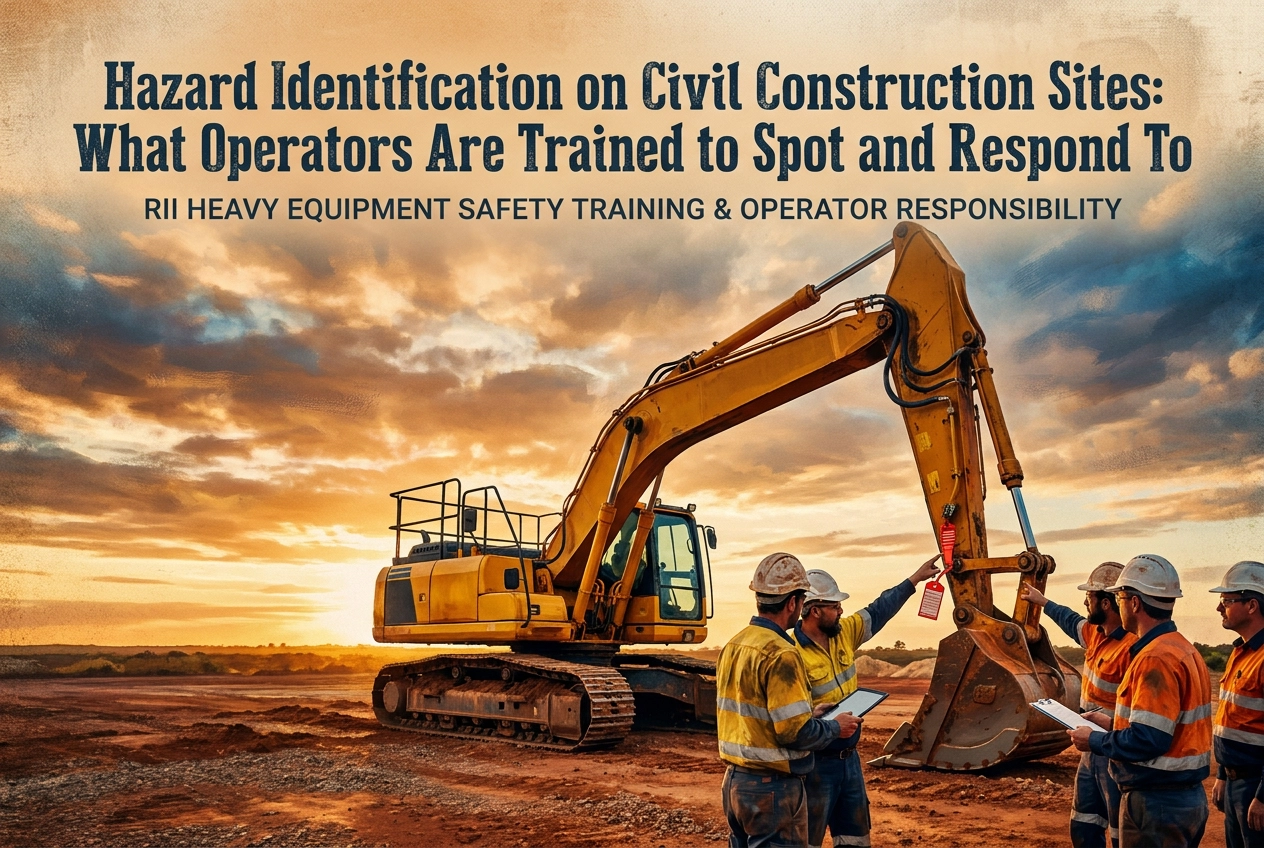
Most site managers assume their operators know how to spot a hazard. That assumption is where the risk begins.
Hazard identification is not something people simply pick up on the job. Within the RII Training Package, it is a structured, assessed competency that operators must demonstrate before they can be considered genuinely capable. And yet, many employers continue to treat heavy equipment safety training as a compliance formality rather than a procurement decision with real legal weight.
This post breaks down exactly what trained operators are expected to recognise and respond to on civil construction sites. You will learn how ground conditions, proximity risks, machine-specific protocols, and emergency response procedures are all built into formal RII training, not left to experience or site inductions to fill in. You will also see what your responsibilities look like under WHS law and why documented competency evidence matters more than you might think.
Whether you are reviewing your current workforce or making decisions about upcoming contracts, understanding what formal training actually covers will change how you think about the operators you put behind the controls.
Hazard Identification Is a Competency, Not a Given
There’s a common assumption on civil construction sites that an operator with ten years behind the controls already knows how to spot a hazard. It’s understandable, but it’s also a risk gap waiting to show itself.
Experience and formally assessed competency are not the same thing. The RII Training Package sets the standard for what an RII ticket actually means on any civil construction site, and it’s explicit on this point: hazard identification units require observable, practical demonstration during assessment, not just a theoretical understanding of risks. An operator can know what a crush zone is without ever having been formally assessed on identifying one in real conditions.
Site inductions don’t close this gap. They cover site-specific rules, entry procedures, and local protocols, which matter, but they are orientation tools. They don’t replicate the structured, assessed competency pathways built into RII courses, and they produce no documented evidence of capability.
That documented evidence is where the legal and procurement weight sits. When something goes wrong on site, “he’s been doing this for years” is not a defensible record of due diligence. Formal RII training produces competency evidence that is verifiable, auditable, and aligned with nationally endorsed standards.
Relying on experience instead of formal assessment means you won’t know the gap exists until it costs you.
Ground and Underfoot Hazards Every Operator Must Recognise
Structured hazard identification starts at ground level, literally.
Unstable ground is one of the most consistently underestimated hazards on civil construction sites. Operators trained through RII courses learn to distinguish compacted from uncompacted surfaces, identify soft fill zones, and assess proximity to excavations before moving plant near them. Ground that looks solid can behave very differently under a loaded machine.
Underground and overhead services require a verified process, not just a visual check. RII training covers the steps operators take before breaking ground, including confirming that appropriate documentation is in place and maintaining safe clearance from marked electrical lines, gas mains, and water pipes. This is a pre-work step, not something assessed on the fly.
Slope and gradient assessment is machine-specific. RII training covers slope and gradient assessment as a machine-specific skill, since acceptable working angles vary by equipment type.
Berm and edge proximity matters most for articulated and rigid haul trucks working near embankments or dump edges, where ground conditions and spatial awareness must work together.
All of this is embedded into pre-operational checks, not treated as a separate safety step.
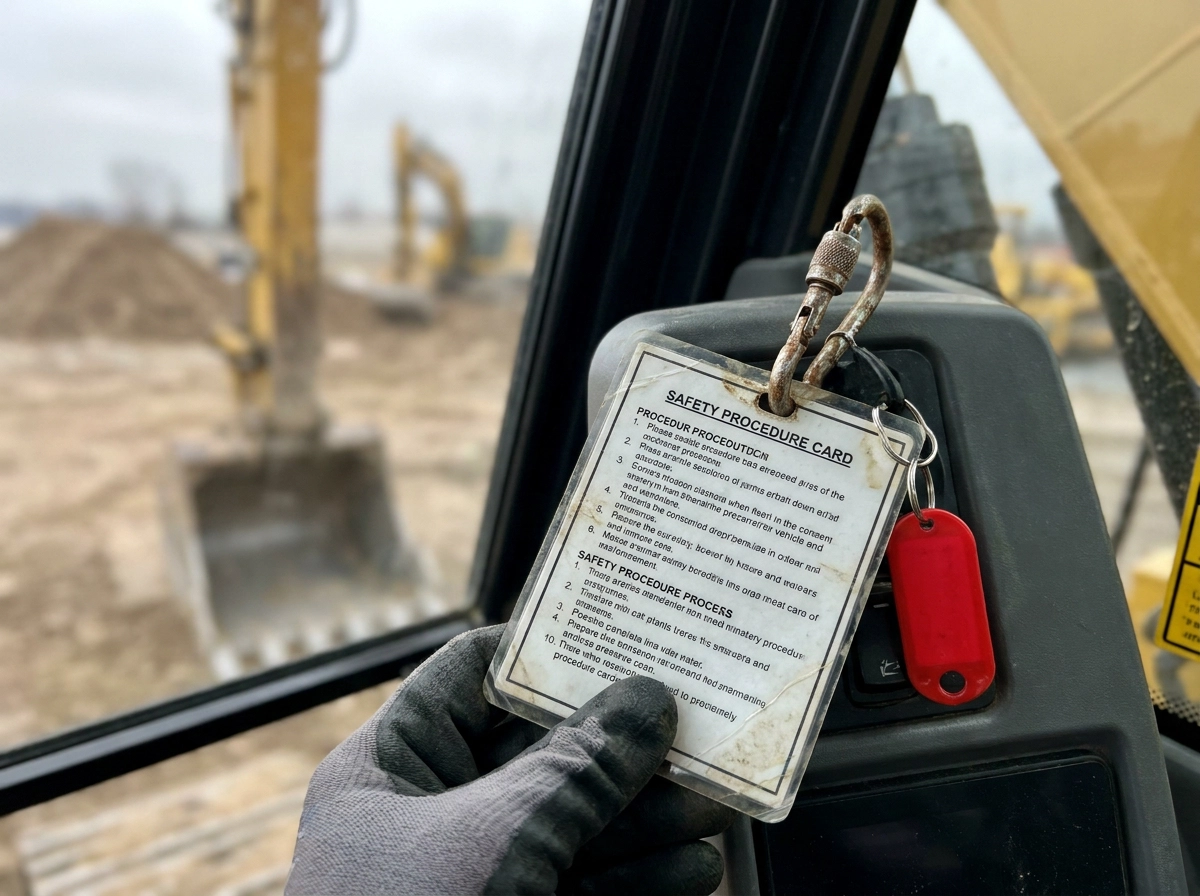
Hazard Protocols That Differ by Machine Type
Ground conditions affect every machine the same way. What changes is everything else.
Each piece of plant on a civil site carries its own hazard profile, and trained operators know those profiles specifically rather than applying a generic checklist across the fleet.
- Excavators: Operators are trained to manage the active crush zone created by the swing radius. During slew, blind spots shift constantly, and RII training covers how spotter positioning must account for that movement in real time, particularly in confined dig areas.
- Wheel loaders and integrated tool carriers: Operators are trained to manage the reduced forward visibility caused by a loaded bucket. RII training covers recognition of tipping load thresholds and the enforcement of pedestrian exclusion zones during active loading cycles.
- Telehandlers: Operators are trained to recognise how extending the boom affects the machine’s centre of gravity and stability, including the bearing pressure considerations under outriggers on soft ground, and the fall exposure that comes with working at height with attachments.
- Articulated and rigid haul trucks: Operators are trained to identify haul road hazards, manage intersections, and maintain safe proximity to edge drop-offs. Reversing on crowded sites without structured protocols is where incidents concentrate, and heavy equipment pre-start checks cover brake and visibility system integrity specific to truck operations.
- Rollers and watercarts: Operators are trained to identify proximity hazards to freshly placed material during compaction work, and to manage the interaction risks that watercart operations create with other plant on site.
RII heavy equipment safety training covers these machine-specific profiles individually because a hazard relevant to a telehandler may be irrelevant on an excavator, and vice versa.
People, Plant, and Proximity: Managing Interaction Hazards on Site
Machine-specific hazard profiles matter, but the bigger risk on most civil sites is what happens when people, vehicles, and multiple machines share the same space simultaneously.
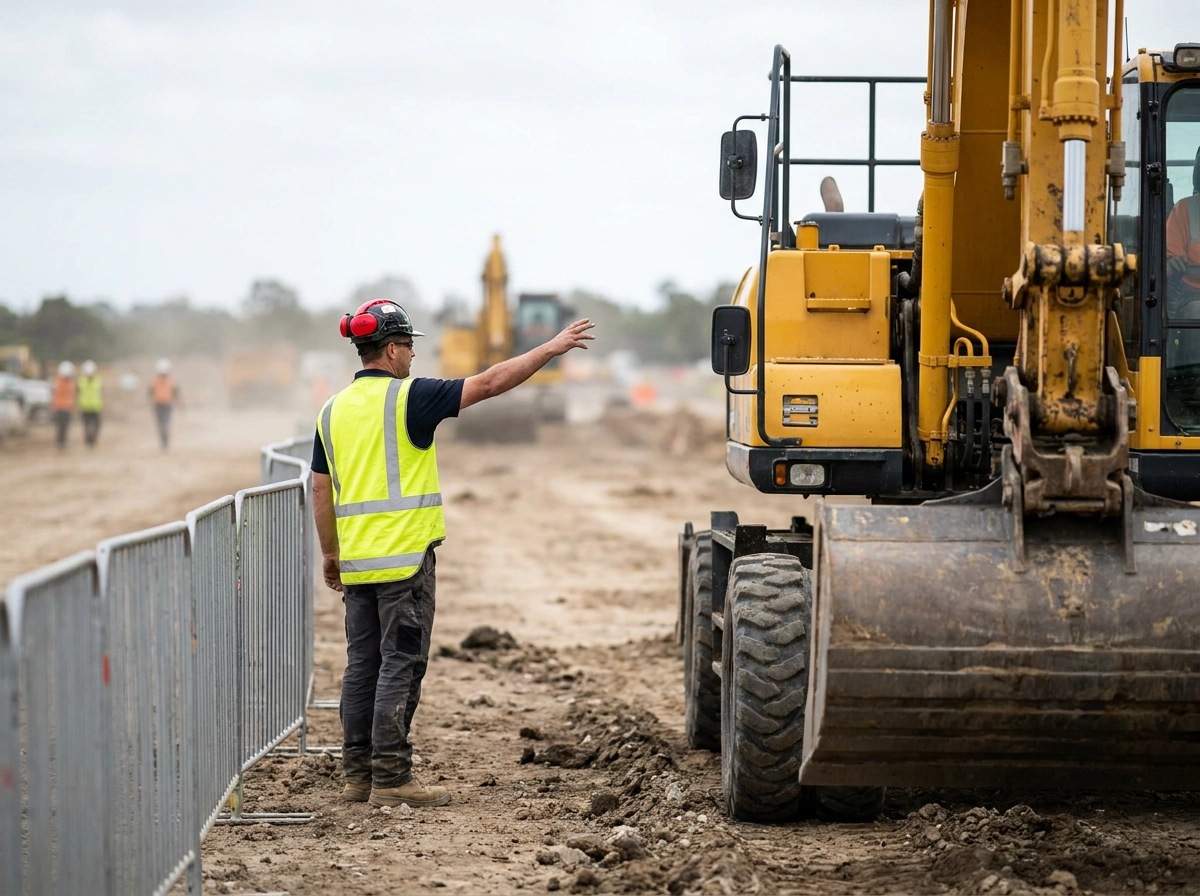
Exclusion zones are a trained behaviour, not a sign you read at induction. RII-trained operators learn to establish and enforce them actively, adjusting boundaries as conditions change rather than treating them as a static rule someone else sets up.
Knowing when to call for a spotter is also a trained decision. Operators are assessed on recognising when visibility is compromised and communicating effectively in noisy conditions, including hand signals and radio protocols. Skid steer loader operators face this constantly given the machine’s compact swing envelope and limited rear visibility.
Traffic management plans and right-of-way conventions are covered as live, operational knowledge. Operators learn how multiple machines moving in the same area create compounding blind spot risks, particularly at haul route intersections.
Pedestrian and light vehicle management gets machine-specific treatment because blind spot geometry differs significantly between an excavator and a telehandler. Understanding which excavator RII ticket applies to your site work matters here because the hazard profiles covered in each course are different.
RII assessment requires demonstrated decision-making under realistic interaction scenarios — that distinction is what separates formal training from a site induction.
Emergency Response: Why It Is Assessed, Not Just Explained
Recognising a hazard in the moment and knowing how to escalate it properly are two very different things. That gap is exactly what emergency response modules in RII courses are designed to close.
The RII Certificate III in Emergency Response and Rescue (RII30919, previously RII30915) was restructured to move beyond mine-specific contexts, extending its relevance to broader resources and infrastructure industries, including civil construction. That is not a minor administrative update. It reflects an industry-wide acknowledgement that emergency competency matters on every site, not just underground or in remote resources extraction.
What operators must demonstrate, not just describe:
- Initial hazard escalation and communication to site supervisors
- Isolation procedures for plant and utilities
- Safe shutdown sequences for specific equipment
- Appropriate response to scenarios including plant rollover, fire on machine, contact with underground services, and operator injury in a remote area of site
Reading a procedure is not the same as executing it under pressure. Formal RII assessment requires operators to physically demonstrate these responses in a practical setting. That distinction matters enormously when something actually goes wrong.
An operator who has only been inducted carries an unverified assumption about their emergency capability. Formal assessment removes that assumption.
Pre-Operational Checks Are the First Line of Hazard Identification
Responding to an emergency is one thing. Spotting the conditions that lead to one is another. That’s where pre-operational checks come in, and in RII heavy equipment safety training, they’re treated as a structured hazard identification task, not a quick walkround before the engine starts.
Trained operators are taught to look for hazards before they enter the work area. Every pre-start inspection covers:
- Fluid levels: engine oil, coolant, hydraulic fluid, fuel
- Structural integrity: frame, ROPS, cab condition, visible cracks or damage
- Tyre and track condition: wear, pressure, grouser height, sprocket and idler integrity
- Hydraulic system: hose condition, cylinder hold, visible leaks
- Controls and alarms: gauge functionality, backup alarm operation, brake response
A thorough check does more than confirm the machine is ready. It reveals developing faults, like a slow hydraulic leak or unusual tyre wear, before they escalate into a site incident. Operators trained on rigid haul truck operations understand this principle applies across every machine class.
Pre-op training also covers environmental conditions. Dust, wet ground and heat all affect machine performance and operator safety, and trained operators know to factor these in before starting work.
Documented pre-start records support a due diligence record — demonstrating that systems were in place and operators were trained to use them.
What Employers Are Actually Responsible For Under WHS Law
Those pre-op check records feed directly into a broader legal picture that every employer and principal contractor needs to understand.
Under the WA Work Health and Safety Act 2020, PCBUs have a duty to ensure worker safety, which requires demonstrating that appropriate systems and verified training were in place. Years on the tools does not satisfy that obligation in the eyes of a regulator or a court.
Relying on informal knowledge transfer or site inductions creates a liability gap that cannot be closed retroactively. If an incident occurs and you cannot produce documented competency evidence, the question of whether that worker was ever formally assessed becomes very difficult to answer in your favour.
Documented competency evidence creates a due diligence record that demonstrates a qualified assessor verified the worker’s ability to perform the task safely. That record is what gives employers and principal contractors a defensible position.
It is also worth knowing that RII Training Package version 4.1, released 28 February 2026, was updated to reflect current industry practice. Older or undocumented training may no longer align with current competency standards, which means gaps can exist even for experienced operators holding outdated tickets.
Keeping Hazard Awareness Current as Sites and Equipment Evolve
Even current qualifications can become outdated if the training behind them hasn’t kept pace with how sites and equipment have changed.
RII hazard identification content is revised as new equipment types, site technologies, and regulatory requirements emerge. Training completed five or ten years ago may not cover risks that are now standard on modern civil construction sites, including:
- Proximity detection systems fitted to plant — sites increasingly feature these, and operators working alongside equipped and unequipped machines need current training to understand the interaction risks involved
- Autonomous and semi-autonomous plant — sites increasingly deploy machines that behave differently to operator-controlled equipment in shared work areas, making current training alignment important
- New attachment types that shift a machine’s centre of gravity and change its stability characteristics in ways older training didn’t address
To verify currency, employers should ask their RTO which version of the RII Training Package their courses are aligned to. The current release is version 4.1 (February 2026). If an operator’s ticket predates significant package updates, a refresher or re-assessment may be worth considering.
How A2B Training Delivers Hazard Identification as a Practical Competency
That practical currency piece leads directly into where the rubber meets the road: who’s actually delivering this training in Perth, and how.
A2B Training is a nationally recognised RTO based in Maddington, Perth, delivering hands-on practical training across a wide range of RII tickets. Courses run six days a week, which means you’re not locked into a Monday-to-Friday window trying to shuffle your crew around.
What sets A2B apart is the hands-on, practical delivery. Pre-operational checks, hazard identification, site safety, and equipment controls are all assessed through observable, practical activities, not just a written test.
The range of nationally recognised RII tickets available covers the machines most commonly found on civil sites:
- Hydraulic excavators
- Wheel loaders and skid steers
- Telehandlers and integrated tool carriers
- Articulated and rigid haul trucks
- Rollers and watercarts
A2B offers training across a range of machine types, making it practical to get operators ticketed across the fleet in one place. That makes formal training a straightforward procurement decision rather than a budget headache.
The Maddington location is easy to access from across the Perth metro area, and six-day availability means operators spend less time off site waiting for the next available course date.
Formal Training Is the Only Way to Know Your Operators Can Spot a Hazard
If your operators hold formal, documented RII tickets, you have evidence they can identify hazards. If they don’t, you’re carrying a gap you may not discover until something goes wrong.
Treating training as a procurement decision means the cost is measurable and the risk reduction is documented.
A2B Training is a nationally recognised RTO based in Maddington, running courses six days a week across a wide range of RII tickets. A2B offers training across a range of machine types, making it practical to get operators ticketed across the fleet in one place.
If you’re ready to sort out your team’s tickets, get in touch with A2B Training to talk through enrolment options, scheduling, or available course dates.
Conclusion
The key takeaways are clear: ground hazards require recognition skills, proximity management requires structured protocols, emergency response requires assessed practice, and pre-operational checks require ingrained discipline. None of these develop reliably without formal training.
Your operators and your business deserve that foundation. Contact A2B Training today to discuss enrolment options and available course dates. Getting your team properly ticketed is one of the most straightforward risk management decisions you can make.