
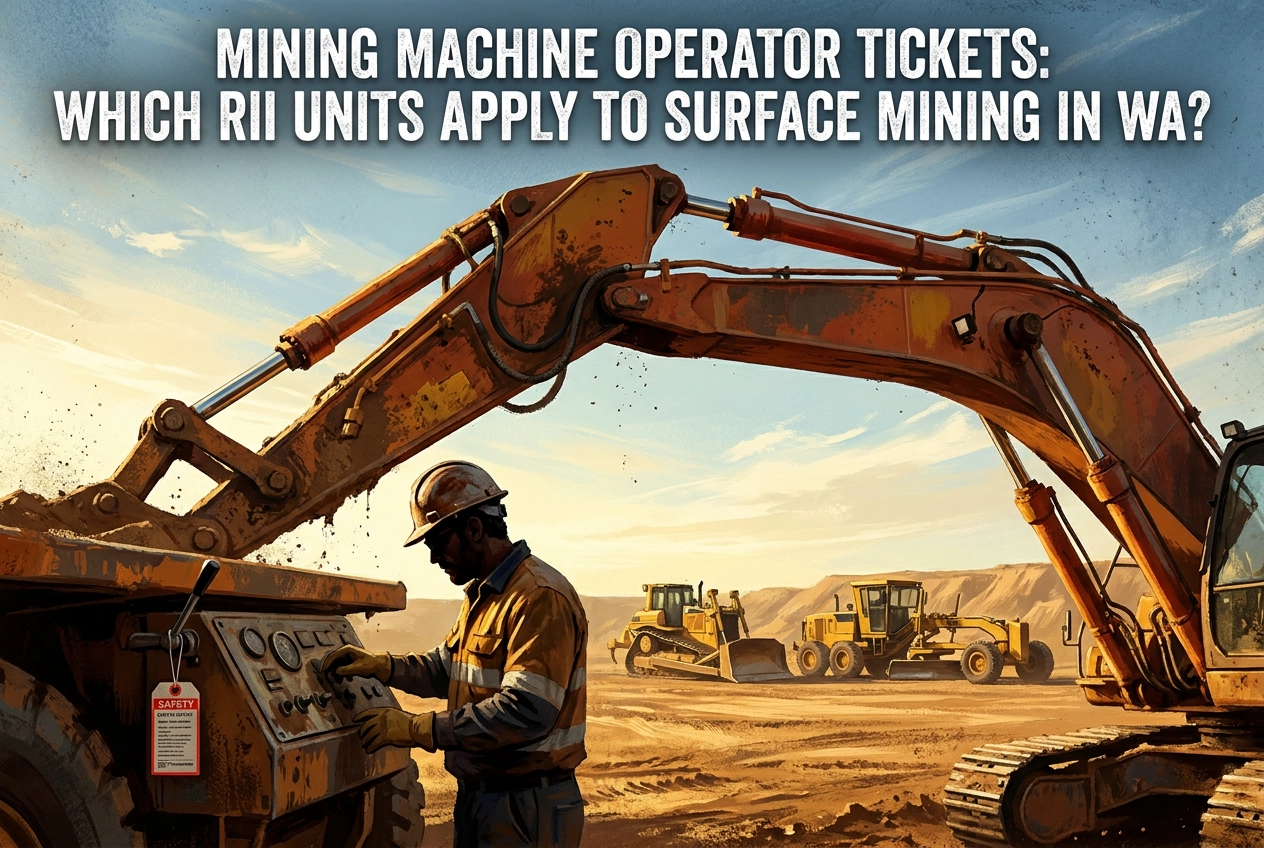
Western Australia’s mining sector is expanding fast, and the demand for qualified plant operators is only heading in one direction. With critical mineral production set to surge over the coming decade, sites across WA need competent, ticket-holding operators behind the controls of excavators, haul trucks, dozers, and more. But here’s where many people get tripped up: there is no single “mining ticket” that covers all of this.
If you’re a mining employer building out your crew, or a mining operator looking to broaden your machine credentials, understanding which RII units apply to which equipment is genuinely useful information. The problem is that most resources either keep it vague or bury the detail.
This guide cuts through that. You’ll get a straightforward, machine-by-machine breakdown of the specific RII units that apply to surface mining equipment in WA, from hydraulic excavators to water carts. You’ll also find a quick reference table, practical advice on building a multi-machine ticket profile, and a clear path to obtaining your credentials through a Perth-based RTO. Let’s get into it.
There Is No Single ‘Mining Ticket’ in WA Surface Mining
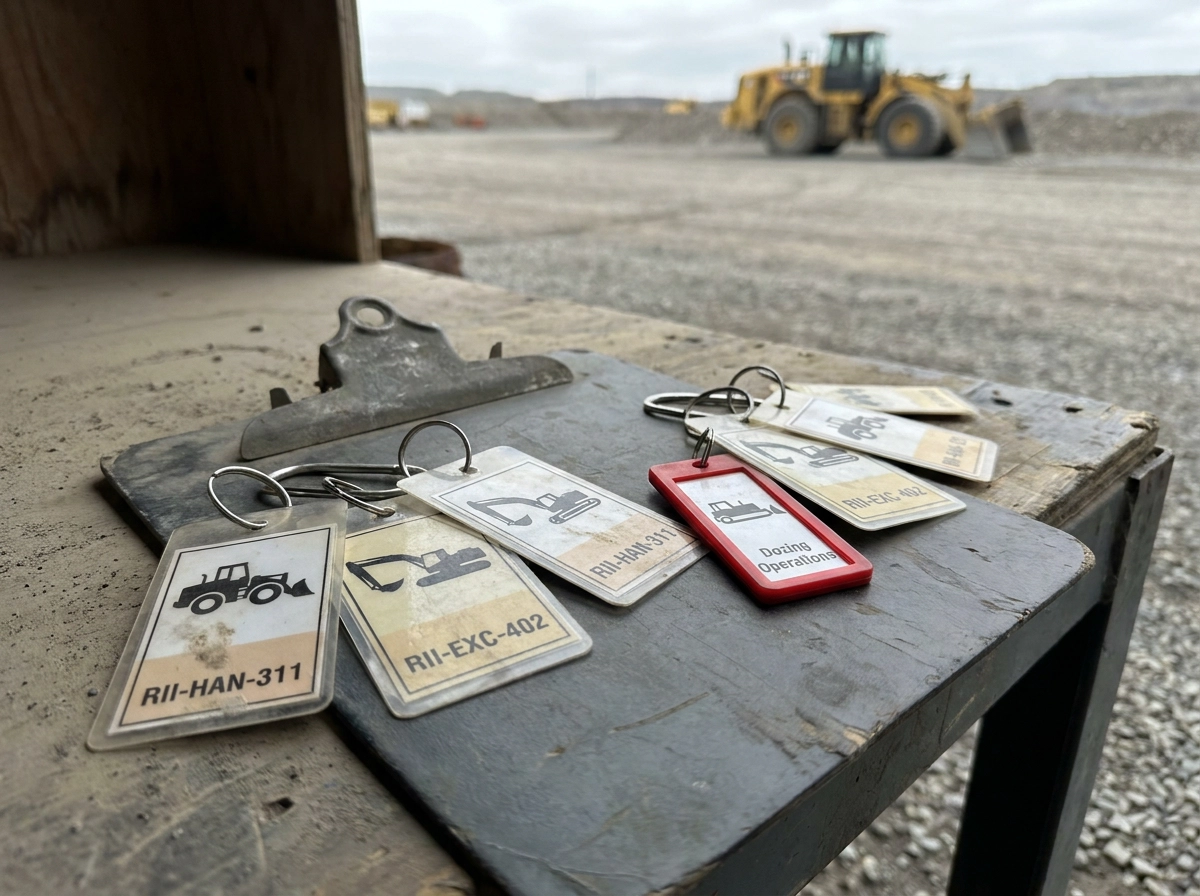
The RII framework and what it actually requires structures competency around specific machines, not broad job categories. Each piece of plant has its own unit code, and operators need the right one for every machine they’re authorised to run. There is no single “mining ticket” that covers everything on a WA surface mine.
WA surface mining employers increasingly audit credentials at the equipment level. A mining plant operator without the correct unit code for their assigned machine can be stood down before they reach the pit. That applies to haul truck operators, excavator operators, and anyone running a water cart or roller on site.
The stakes are rising. Mineral demand from clean energy technologies is projected to reach 15 million tonnes by 2040, up from 7.1 million tonnes in 2020, and 74 new mines need to open before 2035 just to meet lithium demand. Sites need correctly credentialled operators, and they need them now.
RII Units for Surface Mining Equipment: A Machine-by-Machine Reference
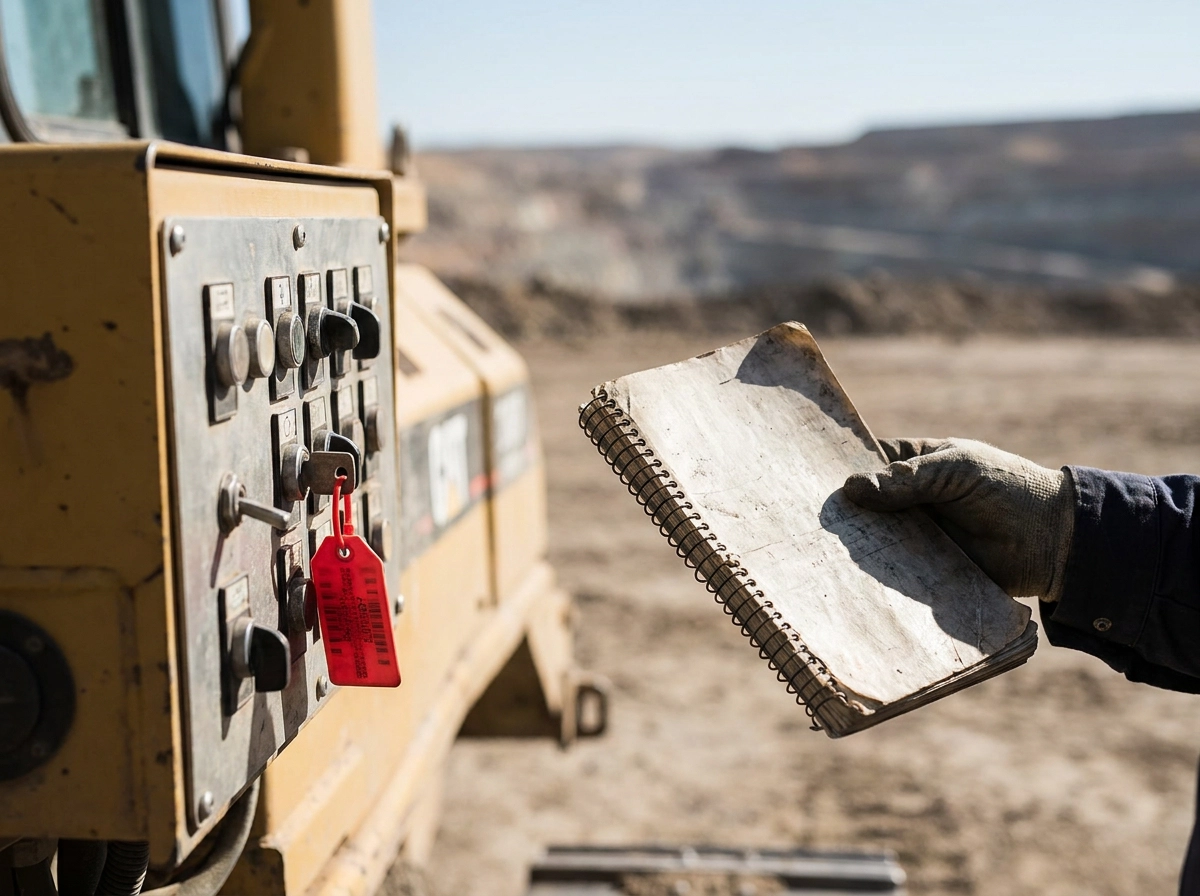
Here’s what each machine entry covers in this guide: the equipment class, its RII unit code, the unit title, and a plain-English note on where it fits into WA surface mining.
All unit codes come from the current RII training package, meaning they’re nationally recognised credentials an RTO can assess and issue in WA. Each section ahead covers one machine class in detail, and a quick-reference table at the end of Section 10 pulls every code into one place for easy credential checking.
A few things worth noting before you dive in:
- This reference covers the equipment classes most commonly deployed on open-cut and surface extraction sites across WA
- Operators should check whether their ticket matches the right excavator unit for their specific context, since civil and mining units differ
- Employers should cross-check these codes against site-specific job role requirements, as supervisory or multi-machine roles may require additional units
Hydraulic Excavator: RIIMPO301E
RIIMPO301E (Conduct Hydraulic Excavator Operations) is the current nationally recognised unit for hydraulic excavator operations. It covers the full operational cycle from pre-start checks and safe setup through to digging, loading, and shutdown procedures, and applies across coal, extractive, and metalliferous mining sectors.
On WA surface mining sites, excavators are the workhorse for overburden removal, bench cutting, and loading haul trucks, which makes this one of the most sought-after credentials for mining equipment operators in the state.
The unit specifically addresses hazard identification and risk controls relevant to excavator work: proximity to other plant, overhead services, and unstable ground underfoot. These aren’t theoretical scenarios on a mine site.
Competency requires practical, hands-on assessment. Passing a written knowledge test alone won’t satisfy the unit requirements, so operators need time on the machine with a qualified assessor.
One thing worth checking: if you already hold a civil construction excavator ticket under an older unit code (such as RIIMPO321F — verify the current suffix at training.gov.au), confirm it aligns with current RII package requirements before presenting it to a WA mining employer. You can book hydraulic excavator operations training through A2B Training, with hands-on practical assessment included.
Rigid Haul Truck
If the excavator is the machine loading the truck, the rigid haul truck unit is the ticket for the operator sitting in it.
Rigid haul trucks are the large, fixed-chassis dump trucks you see moving bulk material around open-cut surface mines. A general heavy vehicle licence does not cover them, and neither does an articulated truck ticket. In a WA surface mining context, you need the specific RII unit for rigid haul truck operations.
The relevant unit covers load and dump procedures, haul road navigation, working alongside excavators and other plant, and fatigue and visibility management, all specific to rigid truck operation. Verify the current unit code for rigid haul truck operations at training.gov.au, as codes have been updated as of September 2026.
WA’s lithium and iron ore sectors are the biggest employers of rigid haul truck operators, and credential gaps in this unit are a common reason site mobilisations stall. With Australian lithium production projected to double to 155.5 kilotonnes by 2030, demand for credentialled operators across new WA surface operations is only heading one way.
Articulated Haul Truck
Where the rigid truck unit covers fixed-chassis machines, the articulated haul truck unit steps in for articulated off-road dump trucks, a genuinely different piece of kit with its own operational demands.
The articulated haul truck course covers the steering, tipping, and load distribution behaviours specific to articulated machines, along with site traffic management requirements. These trucks are the preferred choice on surface mining sites where terrain variability, softer ground conditions, or tighter turning requirements make a rigid chassis impractical.
It’s also a versatile credential beyond mining. Operators who move between civil earthworks and surface mining will find the articulated haul truck unit applies in both contexts, which makes it worth holding regardless of which sector you’re currently working in. Verify the current unit code for articulated haul truck operations at training.gov.au, as codes have been updated as of September 2026.
Water Cart
Water carts often get overlooked in credential planning, but they shouldn’t. The RII unit covering mining-specific water cart operations is a standalone credential for mobile water carts used for dust suppression and haul road maintenance on surface mining and civil sites. Verify the current code directly at training.gov.au, as mining and civil water vehicle units carry different codes.
The role is more demanding than it sounds. A water cart operator on a WA mine site is running a large, fully loaded vehicle on active haul roads alongside rigid trucks and excavators. The unit reflects that reality, covering spray system operation, water source management, haul road conditions assessment, and safe interaction with other plant and site traffic.
One common mistake: assuming a haul truck ticket or a general plant operator credential extends to water cart work. It doesn’t. The water cart unit is its own credential, and sites will require it specifically.
Front End Loader: RIIMPO304E
Loaders appear on virtually every WA surface mining site, and RIIMPO304E (Conduct Wheel Loader Operations) is the unit that covers them. It applies across coal, extractive, and metalliferous mining sectors, making it relevant whether you’re working iron ore, lithium, or gold.
The unit covers pre-start and start-up checks, equipment performance monitoring, hazard management, and post-operational inspection. On a surface mining site that translates to stockpile management, material loading, and cleanup tasks loaders handle daily.
One thing worth being clear on: RIIMPO304E is specifically for wheeled front end loaders. Skid steers and integrated tool carriers are separate machine classes with their own units. If you’re running all three on site, you need all three credentials.
For a solid grounding in the practical side of loader operation, this step-by-step guide to safe and efficient loader operation covers every stage from pre-start through shutdown.
Pairing RIIMPO304E with an excavator or haul truck unit is a smart move for any plant operator looking to increase their value across a typical WA mining fleet.
Skid Steer Loader and Integrated Tool Carrier: RIIMPO320F
Stepping down in scale from the wheeled loader, skid steers and integrated tool carriers fill the gaps in a surface mining auxiliary fleet that larger machines simply can’t reach.
RIIMPO320F covers skid steer loader operations, including the compact, zero-turn machines used for site preparation, material handling, and working in tighter areas where a full-size loader has no business being. The integrated tool carrier — a versatile machine class that accepts interchangeable attachments and crosses between surface mining and civil contexts regularly — has its own unit code; verify the current code at training.gov.au.
Both unit types require demonstrated competency with attachment changes, load handling, and safe operation near edges or in confined working areas. These aren’t corner-case credentials; they’re genuinely relevant for mining plant operators on site establishment, infrastructure maintenance, and remediation work.
On WA surface mine auxiliary fleets, these two machine types frequently appear side by side. Holding both units is a practical way to cover that ground. A2B Training offers skid steer loader operations training with hands-on practical assessment at their Maddington facility.
Skid Steer Loader (Civil): RIIMPO318F
RIIMPO318F (Conduct civil construction skid steer loader operations) is the civil construction variant for skid steer loader operations. Note that RIIMPO318F is superseded as of 01 Sep 2026 by RIIMPO318 (equivalent) — operators and employers should confirm which version applies to their context at training.gov.au.
For roller and telescopic handler operations, the correct unit codes require verification directly at training.gov.au, as the codes previously associated with those machine classes in some references are not accurate for those machine types.
Both haul road upkeep and materials logistics are ongoing on any active WA surface site, and credential gaps in auxiliary equipment create real mobilisation problems.
Quick Reference: Surface Mining Machines and Their RII Unit Codes
Here’s a single-glance reference covering every machine class discussed in this guide.
| Machine Class | RII Unit Code | Notes |
|---|---|---|
| Hydraulic Excavator | RIIMPO301E | Confirmed current unit; supersedes RIIMPO301D |
| Rigid Haul Truck | Verify at training.gov.au | Codes updated as of September 2026 |
| Articulated Haul Truck | Verify at training.gov.au | Codes updated as of September 2026 |
| Water Cart (mining) | Verify at training.gov.au | Mining and civil units carry different codes |
| Water Cart (civil water vehicle) | Verify at training.gov.au | Verify current code at training.gov.au |
| Front End Loader | RIIMPO304E | Applies across coal, extractive, and metalliferous sectors |
| Skid Steer Loader | RIIMPO320F | Verify current suffix at training.gov.au |
| Skid Steer Loader (civil) | RIIMPO318F | Superseded by RIIMPO318 from 01 Sep 2026 |
| Integrated Tool Carrier | Verify at training.gov.au | Verify current code at training.gov.au |
| Roller | Verify at training.gov.au | Verify current code at training.gov.au |
| Telescopic Handler | Verify at training.gov.au | Verify current code at training.gov.au |
Use this as a starting checklist when auditing operator credentials before site mobilisation. It covers the machine types most commonly deployed on WA open-cut and surface extraction operations.
Two quick checks worth making:
- Version suffix matters. Confirm your credential carries the current suffix against the active RII training package version. An older unit code may not satisfy a site’s compliance requirements.
- Load shifting roles need more. Operators performing load shifting tasks may also require RIIHAN309F or RIIHAN311F, the companion rigging and lifting credentials that sit alongside these plant operation units.
Building a Multi-Machine Ticket Profile for WA Surface Mining
Knowing which unit covers which machine is step one. Building a profile across multiple units separates a site-ready operator from one with limited deployment options.
Experienced plant operators often hold credentials across multiple machine classes. More tickets means more roles you can legally fill, directly affecting employability and earning potential.
Common pairings worth targeting:
- Haul truck plus water cart: a practical combo for any surface mining site where dust suppression is an ongoing requirement
- Excavator plus loader (RIIMPO301E and RIIMPO304E): covers two of the most consistently in-demand machine types across WA iron ore, lithium, and gold operations
- Rigid plus articulated haul truck: useful on sites running mixed fleets
A2B Training can assist operators in sequencing multiple units — contact them directly to discuss training plans and availability. Employers can use the same approach to upskill existing staff into broader plant operator roles rather than adding headcount.
Start with the unit your immediate job requires. Add complementary units in the next training block once you’re on site.
Getting Your RII Tickets Through a Perth-Based RTO
Once you’ve mapped out which units you need, the next step is finding an RTO that can actually deliver them.
A2B Training is a nationally recognised, long-established RTO based in Maddington, Perth, covering the full range of RII surface mining unit codes in this guide. Training runs six days a week, so operators can work around shift rosters and employers can schedule crew training without the usual wait.
Assessment is done on real equipment, not simulations. That matters for both competency outcomes and site readiness.
Combo deals are available for operators completing multiple units, which keeps costs down whether you’re self-funding or an employer upskilling a team.
The Maddington location is accessible from across the Perth metro area. More importantly, A2B Training specialises in civil construction and heavy equipment training, so they understand the practical realities of the machines and sites their students go on to work on.
The Right Ticket for the Right Machine
Use the reference table to check your current credential profile against the machine classes on your next site. Gaps are common, and finding them early is far better than a stand-down on site.
If you’re short a unit or want to add machine classes to your profile, A2B Training in Maddington is a straightforward next step. Book a single unit or ask about options to tick off multiple machines in one training block.
With WA’s critical minerals sector expanding fast, a complete and current RII credential profile is one of the most practical ways to stay site-ready. Contact A2B Training to check unit availability, upcoming dates, or build a multi-machine training plan for your crew.
Conclusion
As the reference table in this guide shows, every machine carries its own unit code, gaps in your ticket profile create real site risk, and building a multi-machine credential profile is both achievable and cost-effective with the right RTO.
With WA’s critical minerals sector growing rapidly, operators and employers who stay ahead of their training requirements hold a genuine competitive edge.