

Most civil construction crews don’t have a training problem. They have a planning problem.
When a project kicks off and someone realises the excavator operator isn’t certified for the loader, or the haul truck driver’s ticket lapsed six months ago, the scramble begins. Courses get booked in a rush, operators sit idle waiting for the next available date, and the per-ticket cost ends up higher than it needed to be.
If you’re managing a multi-role crew in Western Australia, there’s a better way to approach construction training Perth employers increasingly rely on: plan your certifications the same way you plan your project phases.
This post walks you through a practical, step-by-step approach to building a multi-ticket training plan for your civil construction crew. You’ll learn how to map your crew roles to the right RII units, sequence certifications around your project timeline, book your operators as a cohort rather than individuals, and take full advantage of available funding. By the time you reach the end, you’ll have a clear framework to take into your next pre-project planning meeting.
Step 1: Map Your Crew Roles to the Right RII Units
Here’s the thing most employers don’t realise until they’re already behind: there’s no single RII ticket that covers your whole crew. Every machine type is a separate competency under the national RII training framework, which means a certified excavator operator isn’t automatically qualified to jump on a roller or a haul truck.
For a typical civil construction crew in Perth, the units you’ll most commonly need are:
- RIIMPO304E – Excavator operations
- RIIMPO321F – Loader operations
- RIIMPO334E – Roller operations
- RIIMPO318F – Rigid haul truck operations
- RIIMPO317F – Articulated haul truck operations
- RIIHAN311F – Watercart operations
Each unit is a separate certification, a separate assessment, and a separate booking. If you’re new to managing this at scale, understanding what an RII ticket actually covers is a solid starting point before you go any further.
Start with a plant inventory, not a headcount. List every piece of equipment on your upcoming project first, then match each machine to its RII unit. That list becomes the foundation of your entire training plan.
From there, pull together a simple spreadsheet: operator names down one column, current tickets across the top. Mark who’s certified, who’s lapsed, and who’s never held a particular unit.
Pay close attention to dual-role operators. Someone who moves between an excavator and a loader on site needs two separate units, potentially sequenced within a tight window. That’s exactly the kind of scenario where leaving planning until the last minute causes real problems.
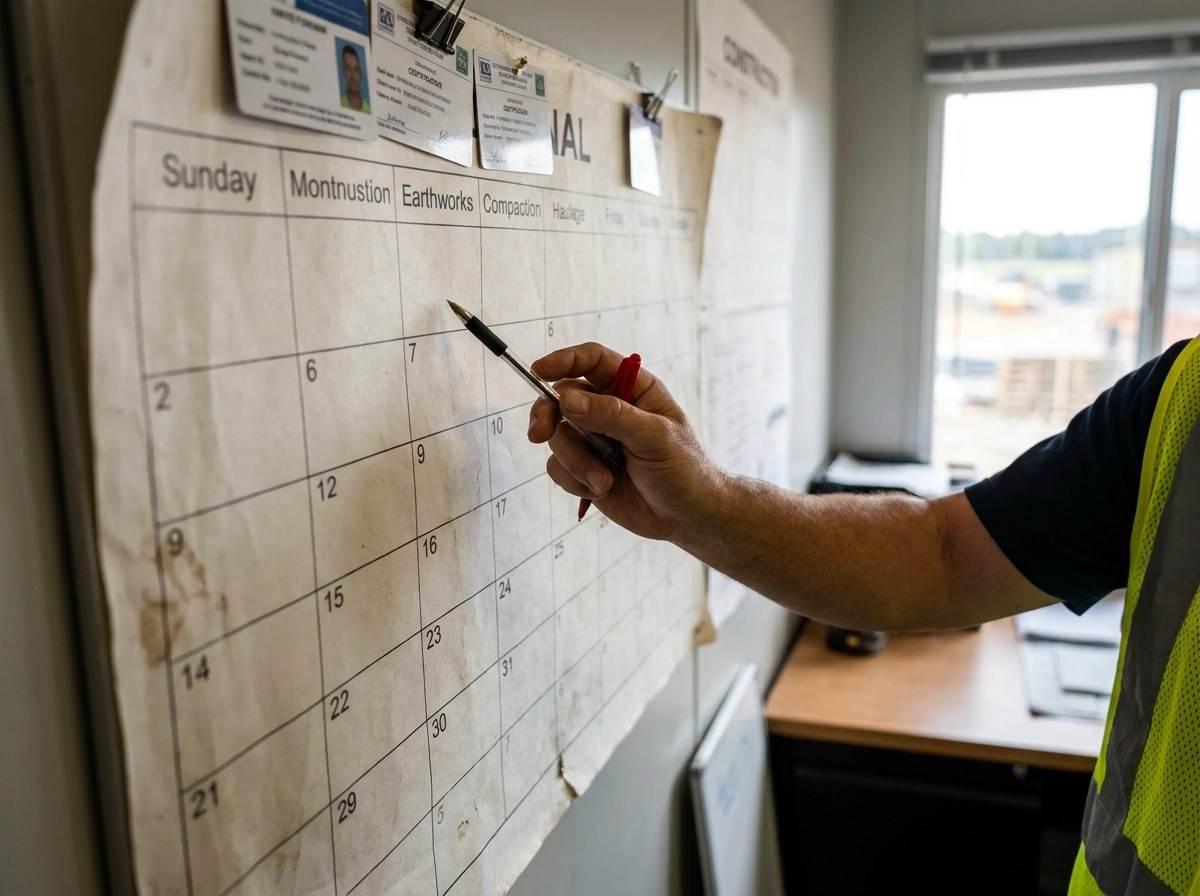
Step 2: Align Certifications to Your Project Timeline
Once you’ve got your crew’s gaps mapped out, the next step is locking those certifications to actual dates on your project calendar.
Start at the end and work backwards. Look at your project schedule phase by phase: earthworks first, then compaction, then haulage. Excavator and loader operators need to be certified and ready 3 to 4 weeks before bulk earthworks kick off. Roller operators need their ticket sorted ahead of compaction works. Haul truck operators should be locked in before haulage routes open. If you’re only thinking about training when plant starts arriving on site, you’re already behind.
Under Australian national standards, civil construction planning requires employers to identify and schedule resources against project milestones. Training certifications are a resource, just like plant hire or materials delivery. They belong in your project schedule from day one, not as an afterthought once mobilisation is already underway. An operator who isn’t certified when their machine arrives creates a compliance problem and a very expensive standstill.
Build a simple timeline that mirrors your project phases. A basic spreadsheet with operator names, required units, target certification dates, and project phase milestones will do the job. If you need guidance on what the practical training for a specific unit actually involves, the practical guide to safe loader operation is a useful reference for understanding what’s assessed under RIIMPO321F.
One thing to check early: flag any operators who need multi-day assessment or have prerequisites for their unit. Those bookings need a longer lead time than a single-day course, and missing that window can throw your whole sequence out.

Step 3: Book Your Crew as a Cohort, Not as Individuals
Once your timeline is mapped, the next move is deciding how you’re booking people through.
Booking operators one at a time is the most expensive way to manage crew certification. You repeat the same scheduling admin repeatedly, operators reach their start dates at different readiness levels, and you miss volume pricing that comes with grouping numbers together.
A cohort-based approach fixes this. Group multiple operators into the same training window, back-to-back days at the same venue, so your RTO can schedule assessor time efficiently and you gain real leverage to negotiate better rates.
Sequencing within that cohort matters too. If three operators need an excavator ticket and two also need a loader ticket, a well-structured plan staggers units across consecutive days rather than stacking everyone into the same session. Nobody sits around waiting, and no machine is idle because its operator isn’t certified yet. (If you’re unsure which excavator unit applies, check which RII ticket your operators actually need before you book as the units are not interchangeable.)
There’s also a compliance admin benefit that’s easy to overlook. One training schedule, one invoice run, one set of certificates to file. Compare that to chasing paperwork across a dozen separate bookings and the difference is significant.
Talk to your RTO early about how many operators you’re putting through across the project. A2B Training has been running construction training courses in Perth as a registered RTO and is well used to working with employers on exactly this kind of coordinated scheduling.
Step 4: Check What the Construction Training Fund Covers
Once you’ve got your cohort plan taking shape, it’s worth pausing to look at one more lever that can meaningfully cut your training spend: the Construction Training Fund.
The CTF is a Western Australian industry levy scheme. If your business pays the CTF levy, you may be eligible to claim back a portion of your training costs. RII units delivered by a registered RTO generally qualify for reimbursement, and a multi-ticket cohort plan covering excavators, loaders, rollers, and haul trucks can add up to a substantial rebate. The CTF even has a dedicated Civil Construction Pilot Program and an online employer funding calculator you can use to estimate your rebate before you commit to a schedule. You can check the CTF Levy and Disbursement Guide for current programme details, including the updated levy threshold that takes effect from July 2026.
To access funding, training must be delivered by a registered RTO. A2B Training is a nationally recognised RTO, so courses like hydraulic excavator operations and the broader multi-ticket units your crew needs are delivered through a provider that meets CTF requirements. Your RTO should be able to advise on exactly what documentation you need to submit with your claim.
This is another place where advance planning pays off. Batching your CTF claims across a whole cohort is far simpler than lodging a separate claim every time one operator completes a course.
If you haven’t explored the Construction Training Fund before, get your finance team and your training provider in the same conversation before you finalise your next workforce plan.
Step 5: Lock In Your Schedule With a Registered RTO Early
Once you’ve sorted your CTF position, the next move is locking in actual dates before your project schedule starts tightening. This is where most employers drop the ball. They finish the planning, intend to book, and then three weeks later they’re scrambling for last-minute spots at a premium.
The earlier you call your RTO, the better your options.
A2B Training runs construction training courses in Perth six days a week from their Maddington facility, and that flexibility is genuinely useful when you’re trying to move a cohort of six operators through two separate RII units inside a fortnight without pulling everyone off site simultaneously. You can stagger days, split the group, and keep the project moving.
Maddington is also a practical location for crews based across the Perth metro area and southern suburbs. More importantly, the facility is built for hands-on, practical training on real equipment. RII competency assessment is meant to test what operators can actually do on a machine, not just what they know on paper.
When you make that first call, bring your training timeline with you. Tell them your cohort size, the units you need, and your project start date. The more lead time you give them, the easier it is to schedule assessors and equipment around your preferred windows rather than whatever happens to be available.
Also ask about combo deals. Booking multiple RII units or putting several operators through together opens up combo pricing that makes multi-ticket planning noticeably more cost-effective than booking one course at a time.
Common Mistakes Employers Make When Planning Crew Training
Even with a solid plan locked in, it’s easy to fall into habits that quietly cost you time and money. Here are the most common planning mistakes Perth employers make with crew training.
Leaving bookings too late. A project gets awarded, mobilisation compresses fast, and suddenly you need four operators certified inside two weeks. It’s the most common issue by far, and entirely avoidable with a bit of forward planning.
Booking operators one at a time. Ad-hoc individual bookings cost more per head, create uneven certification timing across the crew, and turn compliance paperwork into a long-running admin headache. A cohort approach fixes all three problems at once.
Assuming existing tickets are still good enough. RII tickets don’t expire the way a driver’s licence does, but an operator who completed training several years ago may have real skill gaps on modern equipment. Confirm currency and competence before you assume the crew is ready to go. This matters beyond certification too; operators who are shaky on pre-start procedures create safety and liability risks on site. It’s worth reviewing what every operator needs to inspect and record before each shift as part of your crew readiness check.
Leaving Construction Training Fund money on the table. Many Perth employers are eligible for CTF reimbursement but never claim it, usually because the process feels complicated. A registered RTO can walk you through what’s claimable and help you get the paperwork right.
Choosing a provider on price alone. Nationally recognised RII tickets must come from a registered RTO. Beyond registration, hands-on practical training is what actually builds operator competence. Theory alone won’t cut it on a live civil construction site.
Why Perth Employers Use A2B Training for Multi-Ticket Plans
So once you’ve got a clear picture of what not to do, the next question is obvious: who should you be working with to get it right?
A2B Training is a nationally recognised RTO that has been delivering hands-on, practical construction training in Perth for a long time. That experience matters because they understand how civil construction crews actually operate in the field, not just what the unit descriptors say on paper.
Six days a week availability out of their Maddington facility means you’re not fighting for a single Tuesday slot when you need to move six operators through two different RII units across a tight fortnight. You can stagger your cohort across the week without pulling everyone off site at once.
The training itself is practical and hands-on throughout. Operators get real time on actual equipment, which is exactly what RII competency assessment is designed to test. There’s no value in a ticket earned mostly through a slide deck.
Combo deals are available for employers booking multiple RII units or multiple operators, and this is where the advance planning you’ve done in the earlier steps pays off in the budget. Booking a cohort with a structured multi-unit plan is meaningfully cheaper than a string of individual one-off bookings.
Most importantly, the A2B Training team can work with you directly to build a schedule around your project timeline. Bring them a crew list and a project start date and they’ll help you work backwards to a plan that fits. That’s the difference between a training venue and a genuine planning partner.
Start Planning Before the Project Starts
The bottom line is straightforward. A multi-ticket training plan is not a complex document, it is four things done in order: a crew skills audit, a unit-to-role mapping exercise, a project timeline alignment, and one conversation with a registered RTO. That is the whole framework.
The employers who get this right share a few habits. They book early, group their operators into cohorts, ask about combo deals, check their CTF funding eligibility, and treat certification as part of project mobilisation from day one. The ones who struggle are almost always the ones who left training as something to sort out after the job was awarded.
If you are ready to build a proper schedule, reach out to A2B Training with three things: your crew list, your upcoming project dates, and the RII units you need covered. The team will work with you from there.
A2B Training has been delivering hands-on, practical construction training in Perth for a long time. Six days a week, nationally recognised RII tickets, real equipment, and genuine experience working with civil construction crews. That is not a new offering, it is what they have been doing consistently out of their Maddington facility for years.
The crews that hit the ground certified and ready are the ones whose employers planned ahead. By the time a project is awarded and mobilisation timelines start compressing, the planning window has already narrowed. Start the conversation now, before the pressure is on.
Conclusion
Building a multi-ticket training plan for your civil construction crew comes down to four fundamentals: audit your crew’s current tickets, map RII units to each role, align certifications to your project timeline, and book through a registered RTO as a cohort. Do those four things early, and your crew arrives on site certified, confident, and ready to work.
The employers who consistently get this right treat training as part of mobilisation, not an afterthought. They check their CTF funding, book in advance, and have one focused conversation with A2B Training before the pressure builds.
Your next step is simple. Pull together your crew list, your project dates, and the RII units you need covered. Then contact A2B Training in Maddington and let them build the schedule around you.
The planning window closes faster than most employers expect. Start now.