
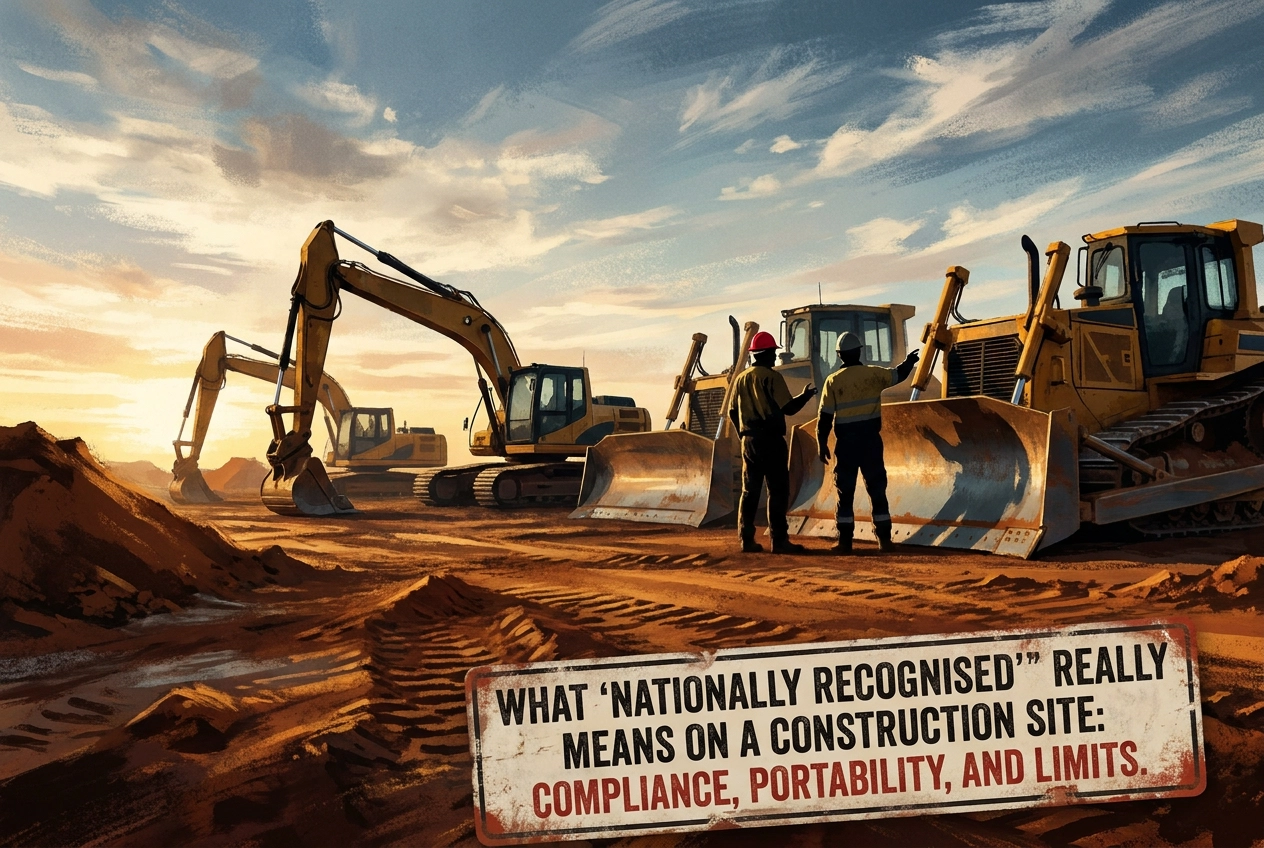
You’ve probably seen the phrase “nationally recognised” stamped on a ticket or qualification and assumed it means you’re good to go anywhere in Australia. It sounds straightforward enough. But if you’ve ever rocked up to a job site interstate and had your construction certification questioned, you’ll know the reality is a bit more complicated than the label suggests.
Nationally recognised training does guarantee that your qualification sits on the national register and must be accepted across all states and territories as a foundational credential. That’s a genuine and important protection. The catch is that “accepted” doesn’t always mean “sufficient.” State-specific licensing requirements, high-risk work overlays, and questions about who actually issued your ticket can all affect whether your credentials hold up under scrutiny.
This post breaks down what national recognition actually covers, where portability works as intended, and where it hits a wall. You’ll also learn why the issuing RTO’s scope of registration matters more than most workers realise, how RPL and gap training fit into the picture, and what to check before you rely on your ticket to get work interstate.
What ‘Nationally Recognised’ Actually Means
When you see “nationally recognised” printed on a statement of attainment, it has a specific, legal meaning. A qualification or unit of competency is nationally recognised when it’s registered on training.gov.au, Australia’s official national training register. That registration means every state and territory is obligated to accept it as a valid credential. It’s not a courtesy; it’s built into the framework.
The system sits on two foundations: the Australian Qualifications Framework (AQF), which sets the learning outcome standards across all qualification levels, and the Standards for Registered Training Organisations, which govern how training is delivered and assessed. The whole architecture was deliberately designed to support workforce mobility, so a worker can pick up and move between states without having to re-prove their competency from scratch.
For civil construction workers, the relevant training package is the RII (Resources and Infrastructure Industry) package. The units you’ll hear about most are the RIIMPO series (plant and equipment operation, covering excavators, loaders, rollers and related equipment) and the RIIHAN series (covering equipment like telehandlers). If you’ve ever wondered what an RII ticket actually is and why construction sites require one, the short answer is: a unit of competency from the RII training package, delivered by a Registered Training Organisation, listed on the national register.
That said, “nationally recognised” signals registration status. It does not guarantee unrestricted acceptance in every work context, and that distinction matters more than most workers realise.
Where Portability Actually Holds Up
For most civil construction roles, the good news is that portability genuinely works. A statement of attainment issued by a properly scoped RTO is a real credential that employers in WA, Queensland, Victoria, or anywhere else in the country are expected to recognise. That’s the system functioning as intended.
The reason it works is that RII units are nationally consistent. Whether you sit your RIIMPO320F Civil Construction Excavator assessment in Perth or Brisbane, the competency standard is identical. The benchmark doesn’t shift at the state border. The same applies to units like RIIMPO321F (Loader) and RIIHAN309F (Telehandler), same standard, same outcome, regardless of where you trained.
Workforce mobility is a deliberate feature of the national training system, not a side benefit. In construction, where project-based work routinely pulls operators interstate for months at a time, that portability has real dollar value.
A federal program targeting experienced construction workers and using RPL-based pathways illustrates how the system is designed to build on this consistency, since those pathways only function because nationally recognised units carry consistent standing across states.
That said, portability works best under specific conditions. The issuing RTO needs to be reputable and properly scoped for the unit they’re assessing. And the unit itself needs to be current. If you hold an older excavator ticket and want to understand where it fits against current unit versions, it’s worth checking before you rely on it on a new site.
Where Portability Breaks Down: State Overlays and High-Risk Work Licences
But here’s where workers get caught out, and it happens more often than it should.
National recognition does not override state-specific high-risk work (HRW) licensing requirements. These are two separate systems, and in some states they run in parallel. Having a valid RII ticket doesn’t automatically mean you’re licensed to operate that equipment in every state.
WA, Queensland, Victoria, and NSW each have their own WHS regulators with independent authority to impose licensing requirements on top of the national training framework. Safe Work Australia acknowledges multiple WHS regulators operate with independent authority, which means state requirements can differ from the national baseline.
Here’s a real scenario worth thinking about. A worker holds a current RIIMPO ticket, say for loader or excavator operations, and relocates interstate for a project. They assume the nationally recognised credential covers them. They arrive on site and discover the destination state requires a separate, state-issued HRW licence for that equipment class. They can’t legally operate the machine without it. That’s a compliance problem on day one, and it’s entirely avoidable.
The clearest way to frame it: your RII ticket is a credential, not a licence. In states where a separate HRW licence applies to your equipment class, you need both. Checking state-specific requirements before you relocate isn’t optional, it is the step that keeps you legally on the tools.
The RTO Scope Problem: Why Who Issued Your Ticket Matters
State overlays aside, there’s another layer that catches workers off guard: even a “nationally recognised” qualification can be worthless if the RTO that issued it wasn’t authorised to do so.
The hard rule, covered earlier in this piece, is that a statement of attainment only carries national standing if the issuing RTO was on scope for that specific unit at the time of assessment.
Being on scope means two things: the RTO is registered with the Australian Skills Quality Authority (ASQA) and that specific unit code appears on their scope listing at training.gov.au. Scope is unit-by-unit, and it can change over time as RTOs add or remove training products.
An RTO can be a legitimate, active, registered business and still not be on scope for a particular unit. If they assessed you for a unit outside their scope, that credential has no national standing, regardless of how professional the course felt.
Verification takes about two minutes. Go to training.gov.au, search the RTO by name or code, and check whether the specific unit code appears on their registered scope. Doing this for RIIMPO334E (roller), RIIMPO304E (excavator), or any other unit before you book is straightforward and worth it.
This is exactly why RTO selection matters. A2B Training, based in Maddington, holds registered scope across the RII units they deliver. Workers doing construction training in Perth through a properly scoped provider can be confident their ticket will hold up on any Australian site.
RII Tickets in WA: What Construction Certification Looks Like in Practice
That RTO scope point lands differently in WA than it does in other states, and here’s why.
In Western Australia, RII tickets are the primary construction certification pathway for heavy plant operators. Excavators, loaders, rollers, telehandlers, skid steers, rigid and articulated haul trucks, and watercarts are among the categories commonly covered. Whether WA requires a separate state-issued high-risk work licence alongside RII tickets varies by equipment category, and workers should verify current requirements directly with WorkSafe Western Australia before relying solely on their RII credential.
A2B Training, based in Maddington, holds registration across a range of RII units in the RIIMPO and RIIHAN series, covering loaders, excavators, rollers, telehandlers, skid steers, rigid and articulated haul trucks, and watercarts. Their training is hands-on and practical, which matters for units where assessed competency includes actual machine operation, not just theory.
For workers needing multiple tickets, A2B’s combo course options and six-days-a-week availability mean you can stack several units in a single block without burning through weeks of unpaid time.
One note for workers relocating to WA with existing RII tickets from another state: check your unit codes against the current versions on training.gov.au. Superseded unit codes can cause friction on WA sites, and it’s a straightforward thing to verify before you start.

RPL, Gap Training, and What They Mean for Your Credentials
If you’ve been running an excavator or loader on site for years, there’s a good chance you already have the skills behind a nationally recognised RII ticket. You just don’t have the paperwork yet. That’s where RPL comes in.
Recognition of Prior Learning is a formal assessment process where a registered RTO evaluates your existing skills and experience against a unit’s competency standard. If you can demonstrate competency, you get the credential without completing full training from scratch. It’s not a shortcut or a loophole; it’s a regulated pathway governed by the same Standards for Registered Training Organisations that apply to every other assessment in the VET system.
Where gaps show up during that assessment, gap training fills them. You only cover what you can’t already demonstrate, which is why completion for experienced workers is typically faster than completing full training from scratch.
The statement of attainment you receive through RPL carries identical national standing to one earned through standard training, provided the RTO was on scope for that specific unit.
That last point matters enormously. A credible RPL outcome requires genuine, practical assessment capability, not just the administrative ability to produce paperwork. RTOs marketing credentials with phrases like “no classes required” or “qualify in seven days” are a warning sign worth taking seriously.
For experienced plant operators, RPL through an established RTO with hands-on assessment infrastructure is the difference between a credential that holds up and one that gets questioned the moment a site supervisor asks how it was issued. The RTO scope requirement covered earlier applies equally here: an RPL credential is only as strong as the registration standing of the provider who issued it.
A Practical Checklist Before You Rely on Your Ticket Interstate
Before you throw your statement of attainment in your bag and head interstate, run through these five checks first.
1. Confirm your unit code is still current. Head to training.gov.au and search your unit code. Supersessions happen more often than most workers realise. RIIMPO318E, for example, was superseded by RIIMPO318F, which has since been superseded again. An older code on your statement of attainment won’t automatically disqualify you, but it can raise questions on site and with some employers. Know what version you hold.
2. Verify the issuing RTO was on scope. Search the provider on training.gov.au and check their registered unit list. An RTO can be legitimately registered and still not have been scoped for the specific unit they assessed you on. If they weren’t on scope at the time of your assessment, the credential doesn’t carry national standing.
3. Check the destination state’s HRW licensing rules. Contact the relevant regulator directly before you assume your ticket is enough. SafeWork NSW, WorkSafe VIC, Workplace Health and Safety QLD, and WorkSafe WA all have their own requirements for certain plant categories. Don’t find out on your first day on site.
4. In WA, consider combo courses to stack tickets efficiently. If you’re building out your RII units, an established, properly scoped provider offering combo deals means more units in fewer days at better value. Worth a conversation before you book.
5. Keep your original paperwork. If your credential gets questioned on site, a clear documentation trail from a long-established RTO resolves it fast. Don’t rely on a digital copy alone.
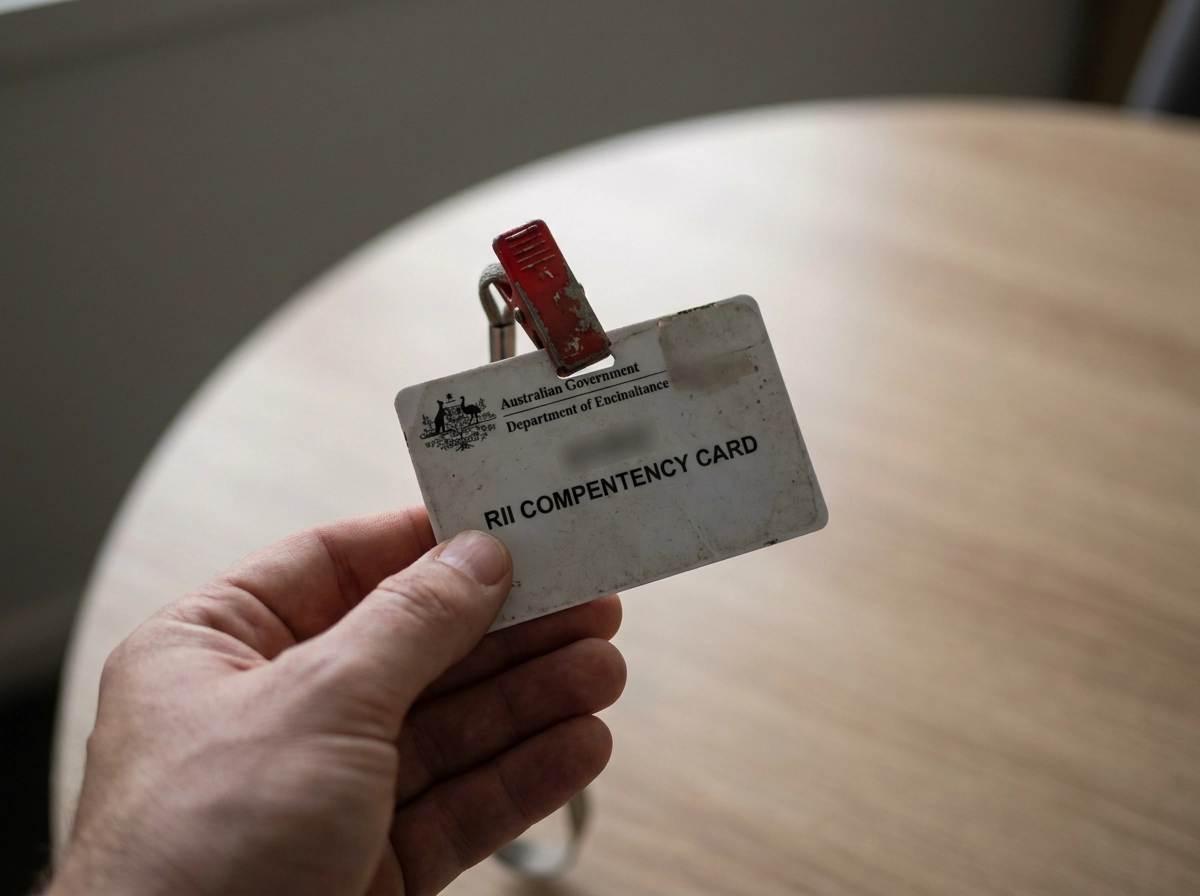
Know What Your Ticket Covers and What It Doesn’t
“Nationally recognised” is a genuine, meaningful status. Your RII ticket was assessed against a consistent national standard and must be accepted across Australia as a valid unit of competency. That’s real, and it matters.
But it’s not a universal pass. Both state high-risk work licensing overlays and RTO scope gaps can catch experienced workers off guard. The unit-currency, RTO-scope, and state-overlay checks covered in the preceding checklist are the three things that turn a nationally recognised credential into one you can rely on.
For workers doing construction training in Perth, A2B Training delivers hands-on practical training across the RIIMPO and RIIHAN range, runs courses six days a week, and offers combo deals that let you stack multiple tickets without burning unnecessary days off work. Their scope is verifiable on training.gov.au. That’s exactly the kind of provider that gives your credential the standing it’s supposed to have.
Know what your ticket covers. Know where it stops. The two together are what actually protect you on site.
Conclusion
Understanding what “nationally recognised” truly means is the difference between a credential that protects you and one that leaves you exposed. Three things determine whether your ticket actually holds up: the currency of your unit codes, the scope of your issuing RTO, and the specific licensing requirements of the state where you plan to work.
Getting these details right is not bureaucratic box-ticking. It is how experienced workers avoid costly surprises when crossing borders or moving between sites.
Before you rely on any ticket, run the checks outlined in this article. Verify your codes on training.gov.au, confirm your RTO’s scope, and research state HRW overlays in advance.
If you are starting fresh or upgrading existing credentials, choose a provider whose scope and assessment standards are verifiable from day one. The right ticket, issued correctly, is one you will never have to defend.