

If you’ve been searching for an excavator and skid steer ticket, you might assume these two machines are basically the same thing, just in different sizes. It’s an easy mistake to make, and you’re definitely not alone in thinking it. But here’s the thing: a skid steer loader is its own machine entirely, with its own operating style, its own attachment capabilities, and its own RII ticketing requirements.
Getting the wrong ticket booked doesn’t just waste your time and money. It can leave you non-compliant on site and back to square one.
This post is here to clear up the confusion. We’ll walk you through what makes the skid steer loader course different, what the training actually covers, why attachments are such a big part of the qualification, and how it stacks up against an excavator ticket. You’ll also learn who needs to complete skid steer loader training, what the ticket doesn’t cover, and how to make sure you’re enrolling in the right unit from the start. By the end, you’ll know exactly which ticket belongs on your resume.
Why People Confuse the Skid Steer and Excavator Ticket
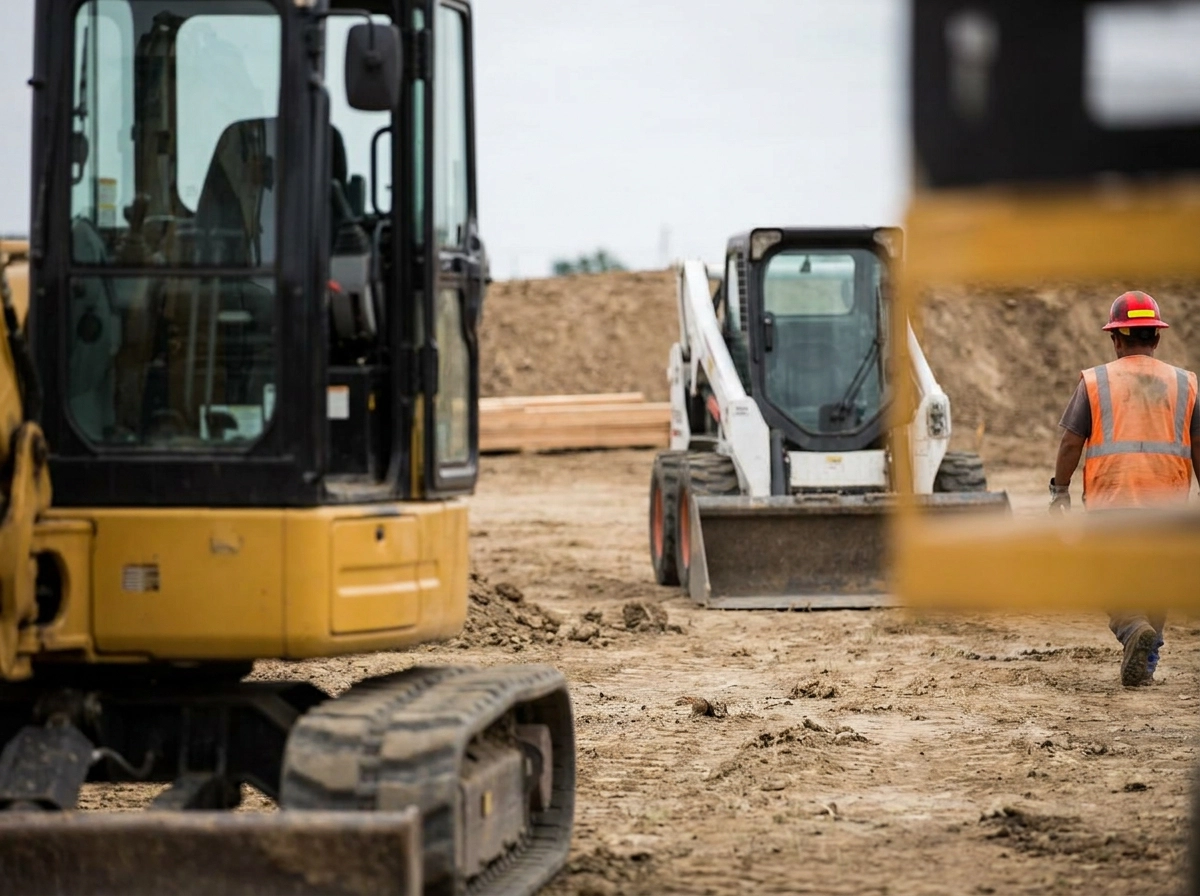
That assumption, common enough to drive a lot of misdirected bookings, stems from seeing both machines on the same site.
But they’re fundamentally different pieces of equipment. A hydraulic excavator uses a tracked undercarriage with a boom, arm, and bucket that swings 360 degrees. A skid steer loader steers by varying wheel speed between its left and right sides, with a front-mounted lift arm designed around interchangeable attachments. Different controls, different mechanics, different site tasks.
That difference carries through into the training framework. Under the RII (Resources and Infrastructure Industry) system, each machine class has its own unit of competency. The skid steer loader training unit and the hydraulic excavator unit are separate credentials; completing one gives you no recognition towards the other.
This matters for employers especially. Booking a worker into the wrong unit means they arrive on site without the correct credential. That’s a compliance issue, and fixing it means re-enrolment, more time off the tools, and extra cost that could have been avoided.
Getting clear on which ticket you actually need before you book is the simplest way to save money and keep your site compliant from day one.
What Is an RII Ticket and Why Does It Matter?
RII stands for Resources and Infrastructure Industry. RII tickets are nationally recognised units of competency confirming a worker has been trained and assessed as competent to operate a specific piece of heavy plant. They’re not attendance certificates; they prove you can do the job safely.
Most civil construction, mining, and infrastructure sites require workers to hold the relevant RII ticket before operating machinery unsupervised. Site principals and principal contractors routinely check credentials, and WHS legislation backs that up.
Each ticket ties to a specific unit code. The skid steer loader unit is RIIMPO318F, superseded by RIIMPO318 from 1 September 2026. Different machines have different codes and different courses. For a deeper look at what RII tickets mean legally and why every civil construction site in Australia requires one, that’s worth a read.
One important detail: training must be delivered by a Registered Training Organisation (RTO) to produce a nationally recognised Statement of Attainment. Not every provider holds RTO status, so it pays to check.
A2B Training is an established RTO delivering RII tickets in Perth, offering hands-on practical training across a wide range of civil construction plant.
A Quick Note on the Unit Code Change: RIIMPO318F to RIIMPO318
On that note, there’s one quick update worth flagging before we go further.
As of 1 September 2026, RIIMPO318F was officially superseded by its updated equivalent, RIIMPO318. If you completed training under the old code, your Statement of Attainment is still valid. Supersession updates the standard for future delivery; it does not wipe out credentials already earned.
For anyone enrolling now, new training should be delivered under RIIMPO318. Employers checking site compliance should confirm their RTO is actually delivering the current unit, not the superseded version.
This kind of update is routine in the RII framework. It happens regularly as standards are reviewed and modernised. The practical implication is simple: check that your training provider is current. An RTO that is still delivering RIIMPO318F after the supersession date is not delivering the current standard. (Worth noting, unit code mismatches in other equipment categories cause real problems too. If you’re sorting out excavator credentials at the same time, this guide on choosing between RIIMPO301E and RIIMPO320F for excavator training is a useful read.)
Whenever you’re comparing RII ticket providers, ask directly which unit code the course is delivered under, and make sure that code appears on your Statement of Attainment. That one question can save a lot of compliance headaches down the track.
What the Skid Steer Loader Course Actually Covers
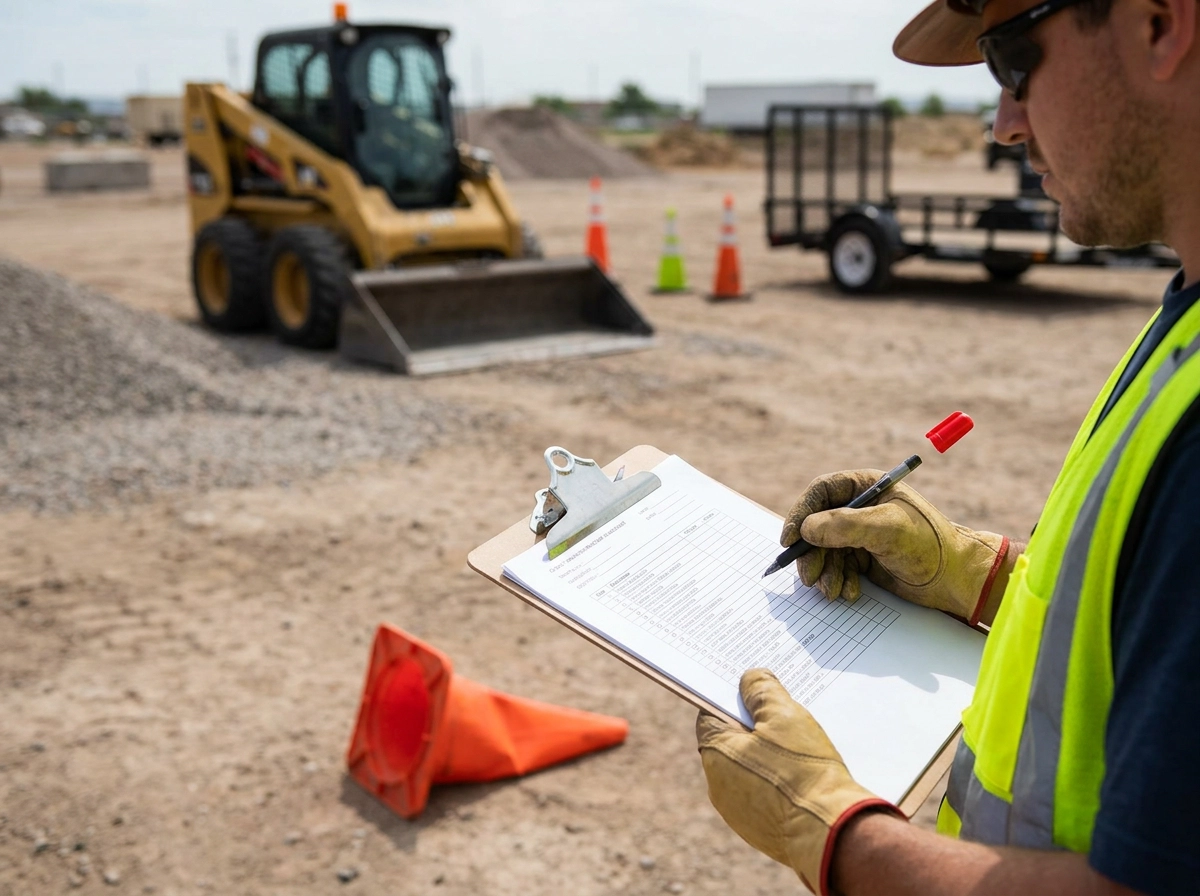
So what exactly do you learn? The course is built around four core elements, and they cover more ground than most people expect.
Element 1: Plan the work. Before the machine moves, you need to demonstrate site planning competency. That means identifying hazards, interpreting traffic management signage requirements, and knowing emergency procedures for your work area.
Element 2: Pre-operational checks. Fluid levels, tyre or track condition, operator restraints, safety systems, and machine controls. At A2B Training, this is assessed hands-on with real equipment, not on paper.
Element 3: Operate the loader. This covers loading, hauling, and distributing materials in site-based conditions, including safe travel on grades, working near edges, and operating around other plant and pedestrians.
Element 4: Attachments. This is where the skid steer unit genuinely stands apart. It is a full standalone competency covering attachment selection, fitting, and safe use, not a quick add-on at the end of the day. Workers must select the correct attachment for the task, verify it against safe working load limits, fit it per workplace procedures, test it before use, operate it within design limits, and store it correctly afterwards.
Why Attachments Make the Skid Steer Ticket Unique
What makes the skid steer genuinely versatile is the sheer range of attachments it accepts. Swap between a standard bucket, pallet forks, auger, broom, grapple, trencher, hydraulic breaker, or grading bucket, and the same machine handles completely different tasks across a single shift. That’s why skid steers show up on civil construction sites, landscaping jobs, utilities projects, and demolition work alike.
Managing attachment changes on a skid steer, including verifying safe working loads, fitting correctly, testing before use, and storing attachments properly afterwards, is a distinct practical skill set. One that the excavator unit does not assess, which is why the two credentials cannot substitute for each other.
This is the core reason an excavator ticket does not qualify someone to operate a skid steer. The controls, coupling systems, and operational context are different enough that each machine requires its own credential.
Skid Steer Ticket vs Excavator Ticket: Which One Do You Need?
As established earlier, the skid steer and excavator units are separate credentials, the decision comes down to machine type and site tasks.
Here is a quick breakdown of where each machine fits:
- Skid steer (RIIMPO318): materials handling, site cleanup, confined areas too tight for larger plant, trenching with auger attachments
- Excavator: bulk earthworks, trench excavation, pipe laying preparation, tasks needing significant reach and precise dig depth
If both machines are on your site and you need to operate both, you need both tickets. It is that straightforward.
For workers or employers deciding where to start, follow the machine. If the job only has a skid steer, get the skid steer ticket. If it has both, plan for both enrolments. A2B Training offers combo options that make completing multiple RII tickets more cost-effective than booking each separately, which is worth factoring in if you know you will need more than one credential down the track.
One Thing the Skid Steer Ticket Does Not Cover
There’s one gap worth flagging before you book anything, and it catches employers off guard more often than you’d think.
Your skid steer ticket covers you to operate the machine on site. It does not authorise you to independently load and unload it from a trailer or low loader. That competency sits under a separate unit, RIIHAN308F ‘Load and unload plant and equipment’.
Without RIIHAN308F, a worker must be supervised by someone who holds that unit whenever the machine needs to go on or off a transport vehicle. On larger sites this is rarely an issue; someone qualified is usually around. On smaller sites, it’s a different story. When the operator is also the person expected to drop the machine off and unload it solo, the compliance gap becomes a real problem.
If your workers need to self-load and unload as part of their regular duties, the compliant approach is to enrol in RIIHAN308F alongside the skid steer unit, not after an incident brings the gap to light.
A2B Training can walk you through which units match your workers’ actual roles before you book. It’s a quick conversation that can save you a costly re-enrolment later, and with combo options available, getting both units sorted at once is often better value anyway.
Who Actually Needs to Complete Skid Steer Loader Training?
So now you know what the ticket covers and where its limits are. The next question is straightforward: does this apply to you?
Civil construction workers on road, drainage, utilities, or earthworks projects are the obvious group. Most commercial sites require a current skid steer credential before you can operate the machine unsupervised, so having the ticket is a basic site entry requirement.
Landscaping and ground maintenance workers are increasingly in the same position. If you’re using a skid steer for materials movement, turf prep, or site cleanup, your employer or the site principal may require the ticket regardless of how informal the job looks.
Labour hire workers benefit significantly from holding their own RII tickets. Agencies place workers faster when the credentials are already in hand, and a skid steer ticket opens doors across civil, landscaping, and utilities projects.
Employers and site supervisors need to book the right unit for the right machine. An excavator ticket does not cover skid steer operation; it is not a workaround, and relying on it creates a compliance problem.
New entrants building a ticket portfolio should note that skid steers appear on almost every civil and landscaping worksite. It’s a practical first credential that adds immediate value.
Getting Your Skid Steer Ticket in Perth with A2B Training
Once you’ve worked out which ticket you need, the next step is finding a good place to get it done.
A2B Training is a well-established RTO based in Maddington, WA, and has been delivering nationally recognised RII tickets for a long time. Their scope covers the skid steer loader unit and a full range of civil construction plant credentials, so whether you need one ticket or several, you’re in the right place.
Courses run six days a week, which makes it a lot easier to fit training around your current job without waiting weeks for a spot to open up.
The Maddington facility is accessible from across the Perth metro area, and training is delivered on real equipment by experienced trainers and assessors who actually know the industry. That hands-on, practical approach matters because site supervisors aren’t just looking for a piece of paper. They want operators who know what they’re doing from day one. Understanding what every operator must inspect before each shift is exactly the kind of practical knowledge A2B builds into their training.
A2B also offers combo deal options for workers needing multiple credentials, which keeps costs down and gets you site-ready faster.
Book the Right Ticket the First Time
The bottom line is straightforward. The skid steer loader ticket is its own standalone credential, with its own unit code, its own course content, and its own competency requirements. It is not a subset of excavator training, and an excavator ticket does not cover skid steer operation.
Here is the short version of who needs what:
- Skid steer operators need RIIMPO318 (formerly RIIMPO318F)
- Excavator operators need the relevant excavator unit for their machine class, confirm the current code with your RTO
- Workers operating both need both, full stop
As noted above, the current unit standard is what matters, confirm your RTO is delivering it. As noted above, RIIHAN308F covers independent loading and unloading, confirm whether your role needs it.
A2B Training’s skid steer loader course (RIIMPO318F) is a practical, hands-on option delivered six days a week at their Maddington facility. As an established RTO, they can also package multiple tickets together if you need more than one credential, which keeps costs down and gets you site-ready faster.
Not sure which units apply to your role? Get in touch with A2B Training directly. With sessions running six days a week, there is almost always a start date just around the corner.
Conclusion
If your role involves a skid steer on any regulated worksite, RIIMPO318 is not optional. Book the right unit from the start with A2B Training, and arrive on site with the credential that actually matches the machine you’ll be operating.