
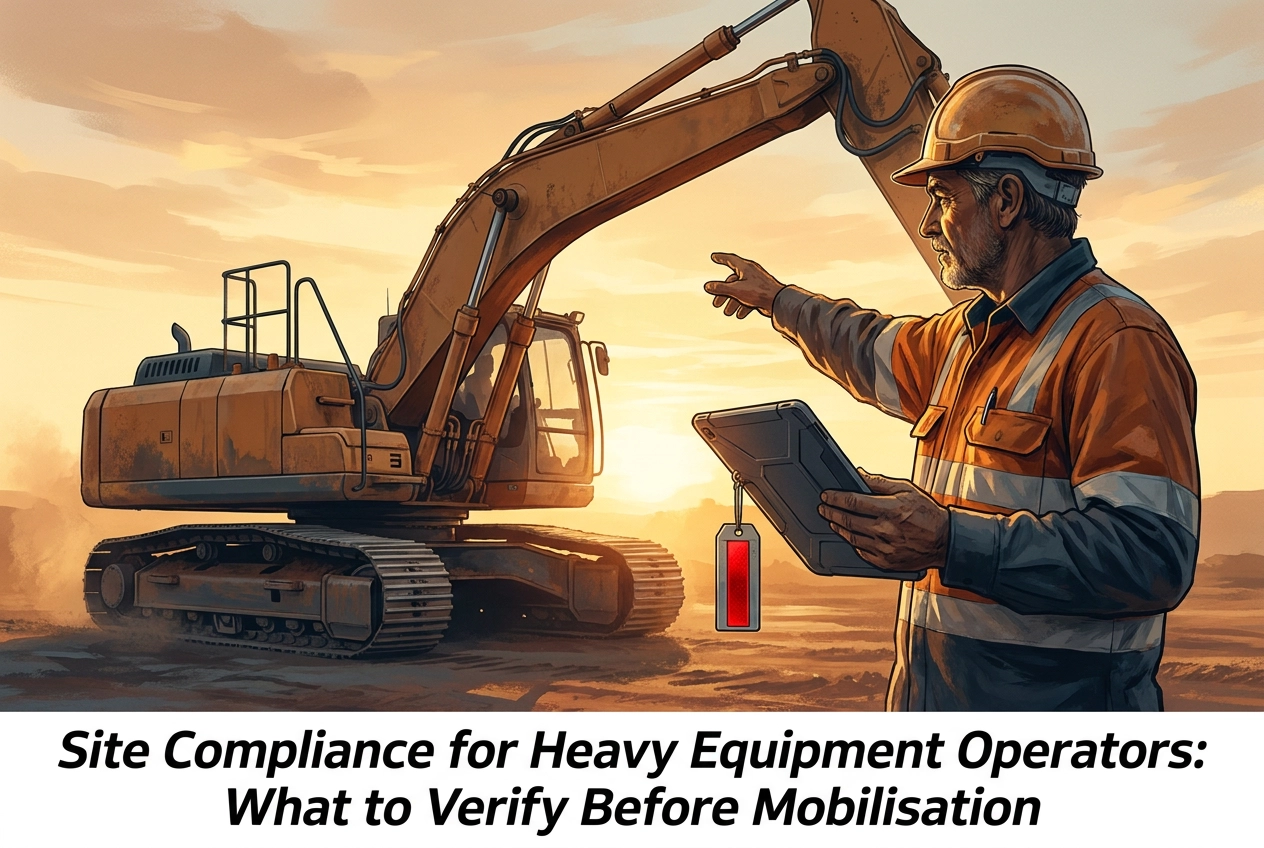
Sending an operator onto site without verifying their credentials is not an administrative oversight. It is a WHS liability with your name on it. That assumption is where compliance gaps become legal exposure.
This post is written for site managers and supervisors who need a clear, practical framework for what to verify before any new operator touches a machine. You will learn how the RII qualification system actually works and where its limits are, how to distinguish a VOC from accredited training, what state overlay licensing requirements most managers miss, and how your verification duty holds even when labour hire or third-party contractors are involved. There is also a pre-mobilisation checklist you can run through every time, not just when something feels off.
If an operator is on your site, the competency check is your responsibility. Here is how to do it properly.
This Is Your Liability, Not HR’s
Under Work Health and Safety legislation, the duty to verify operator competency is non-delegable. It sits with the employer. Not HR, not the labour hire agency, not the operator themselves. If something goes wrong and credentials weren’t properly verified, liability lands on the business conducting the work.
The consequences aren’t administrative. Mobilising an operator with an expired, irrelevant, or unverified RII ticket exposes your business to WHS prosecution, civil liability, and potential insurance complications where policy conditions require verified operator competency.
Understanding what you’re checking matters. The RII (Resources and Infrastructure Industry) framework spans over 500 units of competency across construction, mining, and related sectors. What an RII ticket actually represents, and why every civil construction site requires one is more nuanced than most site managers are briefed on. Ticket verification is a multi-layer task, not a yes/no checkbox.
Construction certification is routinely treated as a one-time onboarding formality. It isn’t. Competency has an expiry. The pre-mobilisation check is the last control point before risk hits the ground.
With Australia’s construction sector forecast to need an additional half a million workers by 2029, workforce pressure will push more operators with documentation gaps through the gate. That makes rigorous pre-mobilisation checks more critical, not less.
What RII Tickets Actually Cover (and What They Don’t)

An RII ticket is a nationally recognised Statement of Attainment issued by a registered RTO after formal training and assessment. It confirms the operator was competent at the time of assessment. It does not guarantee competency is still current.
Each unit code is plant-specific. RIIMPO320F covers civil construction excavator operations. RIIMPO321F (verify scope at training.gov.au before accepting a document) covers a distinct plant class. RIIMPO318F covers skid steer operations. A worker holding one ticket is not covered to operate the others, regardless of seat time claimed. If you want to understand how excavator unit codes differ, the distinction between hydraulic and civil construction excavator tickets is worth reading before you make a booking or accept a document.
Australia does not operate a single consolidated heavy equipment licence; operators are credentialled unit by unit through the RII framework. Your job is to match the unit code on the Statement of Attainment to the exact plant being mobilised. A civil construction wheel loader course produces a different unit code to an excavator course, full stop.
Some operators hold tickets issued under superseded unit codes. Those may still be valid if training was completed before the transition, but check whether your principal contractor or site safety plan accepts the older version first.
The distinction between a Statement of Attainment and a VOC is covered in the next section.
VOC vs. Accredited Training: Know the Difference Before You Accept a Document
That last point leads directly into another document type operators often present, and one that catches site managers off guard.
A Verification of Competency (VOC) is a non-accredited, independent assessment. It verifies whether an operator can currently perform the task safely. It does not issue a Statement of Attainment, and it is not the same as completing an RII unit.
VOCs are typically valid for two years and are widely used as pre-employment checks and contractual site requirements. But they do not replace the underlying RII qualification. An operator needs both: a current RII ticket and, where your site or contract requires it, a current VOC.
Worth flagging to your team: the VET system only guarantees competency at the date of assessment. If an operator completed their RII training two years ago and has barely touched the equipment since, their practical competency may have declined even if the ticket is technically still valid. That is exactly what a VOC is designed to catch.
When reviewing documentation, check for both:
- Statement of Attainment (accredited, no expiry date printed, but operational currency still matters)
- VOC assessment record (non-accredited, two-year validity, check the issue date specifically)
Some principal contractors and site safety plans require a current VOC regardless of whether the operator holds a valid RII ticket. Always verify what your specific project contract and site WHS plan actually require, not just the minimum legal baseline.

The Pre-Mobilisation Compliance Checklist for Site Managers
Now you know what to look for, here’s how to check it before anyone starts an engine.
Step 1: Collect the original Statement of Attainment. Request a physical or digital copy of the operator’s RII ticket. If you don’t recognise the issuing RTO, run it through training.gov.au to confirm it’s a registered training organisation. Unregistered providers do issue documents, they just don’t count.
Step 2: Match the unit code to the plant. The unit code must directly correspond to the equipment being operated on your site. RIIMPO321F (verify scope at training.gov.au before accepting a document); RIIMPO320F covers civil construction excavator operations. One does not cover the other, regardless of how experienced the operator looks.
Step 3: Check unit code currency. Search the unit code on training.gov.au to confirm it’s current or superseded. If superseded, verify whether your principal contractor or site safety plan still accepts it. Some do, some don’t.
Step 4: Confirm VOC status if required. Check the VOC issue date; the standard validity is two years.
Step 5: Check state-specific requirements. Some states require high-risk work licences, site inductions, or state regulator registration on top of the national RII framework. Confirm what applies in your jurisdiction before the operator is on site.
Step 6: Document everything. Record what documents were sighted, the date you checked, and who the operator is. This paper trail is your evidence of due diligence if a WHS inquiry lands on your desk.
Step 7: Set a renewal reminder. Plant operator certifications are valid for two to five years depending on equipment type. Set calendar reminders at least three months before expiry for every operator on your books.
State Overlay Licensing: The Check Most Site Managers Skip
Step 5 in the checklist flags state-specific requirements, but this is where mobilisation documentation most commonly falls short and warrants its own unpacking.
An RII ticket is nationally recognised, but the national framework is a floor, not a ceiling. Every state and territory layers additional licensing, registration, or induction requirements on top of it. Those layers are not optional.
In Western Australia, WorkSafe WA administers a separate plant design and registration framework that sits entirely outside the RII system. Operator competency and equipment registration are distinct compliance obligations. Holding a current RII ticket does not satisfy plant registration requirements, and site-specific safety management systems often impose additional induction requirements.
Beyond WA, high-risk work licences issued by state regulators are mandatory for specific plant classes in most jurisdictions. Check whether the equipment being mobilised triggers a high-risk work licence obligation under your state’s WHS regulations before the operator arrives on site, not after.
If you’re mobilising interstate contractors or running plant across multiple jurisdictions, do not assume one state’s requirements mirror another’s. Contact the relevant regulator directly, or run it past your WHS consultant.
A practical fix: keep a state-by-state compliance reference document covering every plant class your sites use. It takes an afternoon to build and prevents a jurisdiction-specific gap from slipping through under mobilisation pressure.
Labour Hire and Third-Party Contractors: Your Verification Duty Doesn’t Transfer
State overlays add one layer of complexity. Labour hire adds another, and this one catches site managers out regularly.
The misconception is understandable: the agency pre-screens operators, so surely that covers you. It does not. That non-delegable duty extends to every worker on your site, regardless of how they were engaged. A 2024 court judgment (Courtenell WHS, 2024) made this explicit, with two companies hit with combined penalties of $532,000 after relying on third-party assurances instead of direct verification. The engagement method is irrelevant; the duty stays with you.
In practice, this means:
- Request documentation directly from the operator. A verbal confirmation from the agency, an internal spreadsheet, or a registration letter is not verification. Sight the actual documents yourself.
- Apply the same onboarding process to every operator, regardless of source. Statement of Attainment, VOC if your site or contract requires it, and evidence of any state-specific licensing, before their first shift.
- Treat missing documentation as a compliance flag. If the agency cannot or will not produce original RII ticket documentation for independent verification, do not mobilise the operator. Full stop.
The paperwork takes minutes. The liability exposure does not.
RPL-Derived Qualifications: How to Verify They Were Done Properly
The same verification logic applies to another documentation scenario that catches site managers off guard: RPL-derived qualifications.
RPL allows experienced operators to gain a nationally recognised RII qualification by demonstrating existing competency, rather than completing a full training course. The resulting Statement of Attainment looks identical to one issued after formal training. There is nothing on the document that tells you how it was obtained.
The problem is that RPL quality varies significantly between RTOs. ASQA has flagged real risks in this space, including inadequate evidence checks and insufficient practical assessment rigour. As a site manager, you cannot assess assessment quality from the certificate itself. What you can verify is whether the issuing RTO is registered on training.gov.au and whether the unit code is current or accepted.
From a strict compliance standpoint, a Statement of Attainment issued by a registered RTO against a valid unit code is legally sound, regardless of whether it came from RPL or formal training. The pathway does not change the document’s validity.
Where RPL warrants extra scrutiny is in high-risk or complex plant operations. Where doubt exists, a VOC assessment provides independent verification — as described earlier. For critical plant, consider making a current VOC a standard site requirement across the board, not just for RPL cases. It removes the guesswork entirely.
What to Do If You Find a Compliance Gap Mid-Project
Even solid documentation can contain gaps that only surface once work is underway. When that happens, the response matters as much as the discovery.
Stand the operator down immediately. Expired ticket, wrong unit code, missing paperwork, any of these means they stop operating that plant now. Continuing work once you’re aware of the gap doesn’t just maintain the risk; it actively compounds your liability exposure under WHS legislation.
Document the gap and your response immediately — this paper trail is your due-diligence evidence.
Notify up the chain without delay. Project manager, WHS officer, principal contractor, escalate through your site’s non-conformance and incident reporting procedures. This isn’t just good governance; it’s part of demonstrating that your WHS management framework functioned as intended.
Get the operator back in currency. If they have recent practical experience, a VOC assessment or refresher RII training may be all that’s needed. A good RTO can often schedule this within a few days, depending on availability.
Then look at your front-end process. A mid-project discovery almost always points to a breakdown in pre-mobilisation verification, not just an isolated operator issue. Fix the process, not just the paperwork.
Getting Operators Qualified or Back in Currency Fast
Once you’ve identified a gap and stood the operator down, the next question is practical: how quickly can you get them back on plant, legally?
That depends almost entirely on the RTO you choose. Practical, hands-on delivery is what actually builds operating competency; a course heavy on classroom theory won’t get an operator functioning confidently on a machine. Choose the former.
A2B Training is a nationally recognised RTO based in Maddington, WA, delivering nationally recognised RII tickets across excavators, loaders, skid steers, rollers, telehandlers, articulated and rigid haul trucks, and watercarts. Their training is genuinely hands-on, delivered by experienced assessors at a convenient Perth facility.
Training runs six days a week, so operators aren’t waiting weeks for a course slot. For a site manager working against a mobilisation deadline, that scheduling flexibility is worth a lot.
A2B Training offers training across multiple plant categories, so operators needing more than one ticket can complete them through a single provider. If you need an operator qualified on more than one machine, or want to get several tickets completed in a single training block, that is a straightforward way to reduce downtime and get better value from the spend.
Convenient location, flexible days, value-for-money pricing, and practical delivery; it’s a solid option when currency matters and time is short.
Run the Check Every Time, Not Just When You Remember
Getting operators trained is only half the job. The other half is making sure the check actually happens, every single time, without exception.
Pre-mobilisation verification is not a one-time onboarding task. It applies to every operator, every plant class, and every site engagement, including workers returning from a previous project whose tickets may have quietly lapsed in the interim.
The six-step checklist above covers every element; apply it without exception, including for returning workers and labour hire operators. Renewal reminders set three months out (as noted in Step 7) prevent expiry surprises on live projects.
If a gap turns up, address it before mobilisation. A day of retraining costs far less than the liability exposure attached to an incident involving an operator whose documentation was never properly verified.
For WA-based operators needing RII tickets or a currency refresh, A2B Training offers practical, nationally recognised training six days a week, with training available across multiple plant categories.
Conclusion
Site compliance for heavy equipment operators is not a box-ticking exercise. It is a direct reflection of how seriously you take your duty of care, your project liability, and the safety of every person on site.
The key takeaways are straightforward: RII tickets must match the exact plant class being operated; VOC and state overlay requirements sit on top of national qualifications, not beneath them; and your verification duty does not transfer to labour hire agencies or third-party contractors.
Most compliance failures are not deliberate. They happen because the check was skipped, delayed, or assumed. Building a consistent pre-mobilisation process eliminates that risk entirely.
Start with the checklist. Document what you sight. Set expiry reminders. Address gaps before the job starts, not after an incident forces your hand.
Verify every operator, every time. That single habit is what separates a defensible compliance record from an avoidable liability.